Revenue recognition, Investments, Cost structure, Debt and Financing
On this page you will find information on Valmet's revenue recognition standard practices, critical accounting estimates and judgements, as well as contract and project durations. Investments are broken down per year with gross capital expenditure data based on location. You will also find a breakdown of Valmet's cost, debt and financing structure.
Valmet delivers process automation, machinery, equipment and services for the pulp, paper, energy and other industries. On the capital business side, the Group’s revenue arises from projects, the scope of which ranges from delivery of complete mill facilities on a turnkey basis to single section machine rebuilds, that may or may not include process automation solutions. Service business revenue includes revenue from short-term and long-term maintenance contracts, smaller improvement and modification contracts, rebuilds, as well as sale of spare parts and consumables.
Revenue is recognized to depict the transfer of promised goods or services to the customers in an amount that reflects the consideration to which Valmet expects to be entitled to in exchange for those goods or services. The timing and method as well as unit of revenue recognition are determined in accordance with the five-step model of IFRS 15 as follows:
Step 1: Identification of the contract(s) with a customer Step 2: Identification of the performance obligations in the contract Step 3: Determination of the transaction price attached to the contract Step 4: Allocation of the transaction price to the performance obligations identified in the contract Step 5: Recognition of revenue when (or as) the entity satisfies a performance obligation
In long-term capital projects involving delivery of both equipment and services, one or more performance obligations are identified. The identification of performance obligations depends on the scope of the project and terms of the contracts, and largely follows the level at which quotes are being requested by the customers on capital projects.
In short-term service contracts that involve delivery of a combination of equipment and services, depending on the scope of the contract and terms attached thereto, one or more performance obligations are identified. When scope of the contract involves services provided at the customer site, such as installation, maintenance, technical support or mechanical audits, these are typically considered as a separate performance obligation from delivery of significant equipment and services provided off-site. On the other hand, when services in the scope of the contract are performed at Valmet premises only, such as workshop services, material and services typically cannot be identified separately, and consistently only one performance obligation is identified.
In long-term service contracts where Valmet’s activities are largely performed at the customer’s site, depending on the contract and terms attached thereto, one or more performance obligations are identified. When the scope of the contract involves various service elements that are sold separately on a stand-alone basis, these elements would typically be determined to consist of performance obligations on their own.
Revenue is recognized when a customer obtains control of a good or service. A customer obtains control when it has the ability to direct the use of and obtain the benefits from the good or service, either over time or at a point in time.
When Valmet determines that control on goods or services is transferred over time, this is typically based on either that customer simultaneously receives and consumes benefits as Valmet performs, or that Valmet’s performance creates an asset with no alternative use throughout the duration of a contract and Valmet has enforceable right to payment for performance completed to date.
Deliverables within Valmet’s product offering that have the characteristics of the first criterion include mill maintenance services or other field services provided under long-term contracts, in which the receipt and simultaneous consumption by the customer of the benefits of Valmet’s performance can be readily identified. Deliverables with the characteristics of the second criterion include capital projects where the scope of the contract involves design and construction of an asset according to customer specifications. The assets created in these projects do not have alternative use because the design is based on specific customer needs. When revenue is recognized over time, progress towards complete satisfaction of the performance obligation is measured using the cost-to-cost method. The cost-to-cost method is estimated to result in a revenue profile that best depicts the transfer of control on the deliverables to the customer.
Recognition of revenue at a point in time is applicable, among others, in contracts where services are performed at Valmet’s premises, and deliveries of spare parts and consumables. Control of deliverables typically transfers based on the delivery terms used, at the takeover, or at a later point in time when customer acceptance is received.
Critical accounting estimates and judgements
For performance obligations satisfied over time, Valmet uses cost-to-cost method to recognize revenue as it best depicts the transfer of control to the customer as Valmet performs. Under cost-to-cost method, progress towards complete satisfaction of performance obligation is measured based on the ratio of costs incurred to date to the total estimated costs at completion of the performance obligation. Revenues, including estimated profits, are recorded proportionally as costs are incurred. Management regularly reviews the progress of and execution on performance obligations. As part of the process, management reviews information including, but not limited to, key contractual obligations outstanding, project schedule, identified risks and opportunities, as well as changes in estimates of revenues and costs. A projected loss on a customer contract is recognized in full through profit or loss when it becomes known.
Valmet regularly enters into contracts where the consideration includes one or more variable elements. Variable consideration is estimated by using either the expected value or the most likely amount -method, depending on the type of the arrangement. In making judgments about variable consideration, Valmet considers historical, current and forecast information. Impact of changes in estimates is recognized in revenue in the period when the estimate is updated.
Typical contract and project durations
Long-term Services contract durations
Maintenance outsourcing: 6 years
Fabrics and consumables: 3 years
Pulp and Energy and Paper project durations
Pulp mill projects: 12 - 24 months
Power plant projects: 12 - 24 months
Paper business ine projects: 12 - 24 months
EUR million
2025
2024
2023
2022
2021
2020
2019
2018
2017
2016
2015
2014
2013
(carve-out)
Cash flow provided by operating activities
581
554
352
36
482
532
295
284
291
246
78
236
-43
Gross capital expenditure (excluding business combinations and right-of-use assets)
-103
-107
-125
-112
-97
-89
-79
-79
-66
-60
-44
-46
-54
Proceeds from sale of fixed assets
3
2
6
2
2
1
6
6
2
2
3
4
4
Business combinations, net of cash acquired and loans repaid
1
-135
-415
117
-15
-48
-163
-2
-
-
-323
-
-3
Cash flow after investing activities
484
316
-181
56
382
-60
58
208
227
188
-287
-194
-97
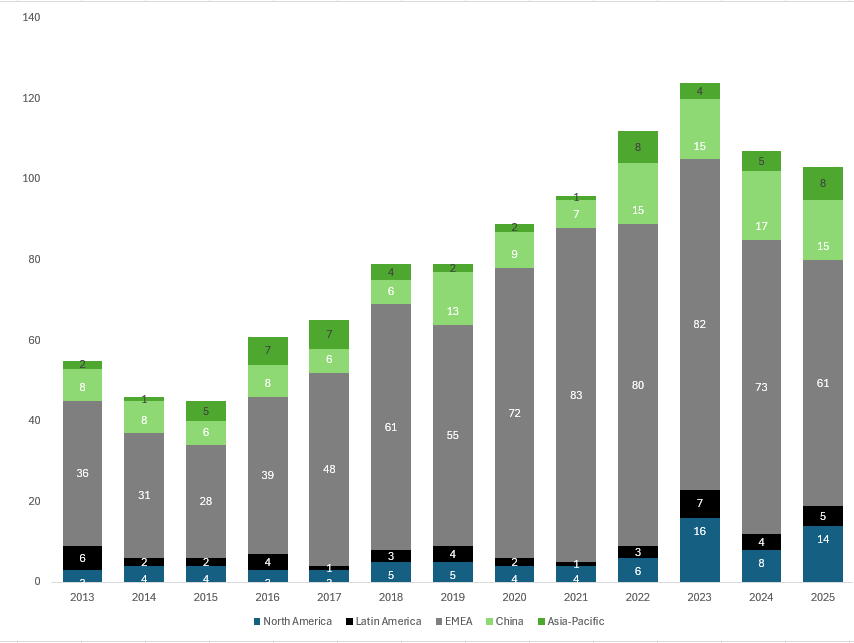
Gross capital expenditure (excluding business combinations and right-of-use-assets) by location, EUR million
In this section you can find information about Valmet’s cost structure. For more detailed information see Valmet’s Financial Statements 2025.
Consolidated statement of income
Valmet’s biggest expenses in 2025 were Cost of goods sold, Selling, general and administrative expenses (SG&A) and Income taxes.
EUR million
2025
2024
Net sales
5,197
5,359
Cost of goods sold
-3,750
-3,878
Gross profit
1,447
1,481
Selling, general and administrative expenses
-986
-1,000
Other operating income
25
25
Other operating expenses
-53
-2
Share in profits and losses of associated companies
5
2
Operating profit
438
449
Financial income
18
24
Financial expenses
-80
-90
Profit before taxes
376
383
Current tax expense
-138
-119
Deferred taxes
42
17
Income taxes, total
-96
-103
Profit for the period
279
281
Attributable to:
Owners of the parent
280
280
Non-controlling interests
-
1
Profit for the period
279
281
Earnings per share attributable to owners of the parent:
Earnings per share, EUR
1.52
1.52
Diluted earnings per share, EUR
1.52
1.52
Personnel expenses (included in Cost of goods sold and SG&A)
Milj. euroa
2025
2024
Salaries and wages
1,093
1,093
Pension costs, defined contribution plans
109
110
Defined benefit plan costs
6
6
Other post-employment benefits
12
12
Share-based payments
7
8
Other indirect employee costs
168
164
Total
1,395
1,393
Personnel at end of the period
18,487
19,310
Average number of personnel during the period
18,982
19,297
Selling, general and administrative expenses (SG&A)
EUR, million
2025
2024
Selling, general and administrative expenses
498
495
Research and development expenses, gross
126
123
Administrative expenses
361
383
Total SG&A expenses
986
1 000
Income taxes
EUR, million
2025
2024
Profit before taxes
376
383
Taxes calculated according to tax rate in Finland
-75
-77
Impact of changes in tax rates
-
-
Income tax for previous years
-8
6
Net increase (decrease) in uncertain tax positions
-10
-
Effect of different tax rates in foreign subsidiaries
-10
-15
Utilization of tax losses carried forward
-1
-1
Non-recoverable foreign taxes
-12
-12
Adjustment and revaluation of deferred taxes for previous years
15
1
Effect of tax-free income and non-deductible expenses
1
-3
Other
4
-2
Income tax expense
-96
-103
Effective tax rate, (%)
25,7
26,8
Effective tax rate, (%) excluding income tax for previous years
20,9
28,5
Depreciation and amortization
EUR, million
2025
2024
Cost of goods sold
-65
-67
Selling, general and admnisitrative expenses
Marketing and selling
-8
-6
Research and development
-5
-6
Administrative
-130
-138
Total
-209
-219
Key figures
As at December 31, 2025
As at December 31, 2024
Interest-bearing liabilities
EUR 1,461 million
EUR 1,544 million
Current debt (including portion of non-current debt)
EUR 132 million
EUR 115 million
Non-current debt
EUR 1,153 million
EUR 1,272 million
Net interest-bearing liabilities
EUR 904 million
EUR 1,032 million
Average maturity of non-current debt
3.3 years
3.4 years
Average interest rate
3.4%
4.0%
Key debt ratios
As at December 31, 2025
As at December 31, 2024
Gearing
35%
39%
Equity ratio
45%
44%
Net debt to EBITDA ratio
1.40
1.55
Debt instruments and credit facilities as at September 30, 2025
Undrawn committed revolving credit facility of EUR 450 million
Unused commercial paper program worth of EUR 300 million
Schuldschein loan of EUR 375 million, of which EUR 281 million was outstanding at the end of the reporting period.
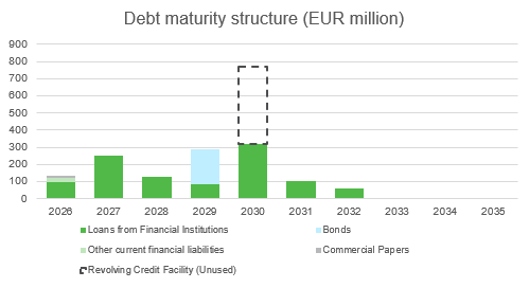
Debt maturity structure as at December 31, 2025 (excluding lease liabilities)
Schuldschein loan
On December 12, 2025, Valmet completed its first Schuldschein loan transaction, amounting to EUR 375 million. The transaction strengthens Valmet’s long-term debt structure, diversifies funding sources and broadens Valmet’s debt investor base.
Valmet announced on March 1, 2024, that it has established a Green Finance Framework applicable for the issuance of green debt instruments to further integrate its ambitious sustainability targets into its financing.
Valmet’s Green Finance Framework has received an independent second party opinion from ISS ESG, confirming the alignment of the framework with the Green Loan Principles 2023 and the Green Bond Principles 2021.