Valmet's approach to human rights

Valmet is committed to respect and promote human rights and acknowledges that promoting human rights is fundamental for carrying out its business in a responsible manner.
Our commitment to respect and promote human rights is founded in our Human Rights Policy Statement and fully integrated into our operating policies, such as Valmet's Code of Conduct, Supplier Code of Conduct, and other related guidelines. We operate in full compliance with all applicable national and international laws, regulations, and generally accepted practices as well as our own Code of Conduct, whichever sets higher standards.
As a global company and employer, Valmet respects and promotes the protection of human rights as expressed in all internationally recognized human rights declarations and conventions, such as
- the United Nations (UN) Universal Declaration of Human Rights
- the UN Covenant on Civil and Political Rights
- the UN Covenant on Economic, Social and Cultural Rights, and
- the International Labor Organization’s (ILO) Declaration of Fundamental Principles and Rights at Work.
How we put our commitment into practice
We have a Sustainability Due Diligence Process to ensure compliance with human rights-related commitments. The framework is based on the principles set out in the UN Guiding Principles on Business and Human Rights and the OECD Guidelines for Multinational Enterprises.
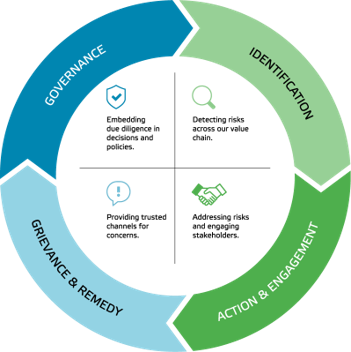
Valmet's human rights due diligence process includes:
- Governance: embedding due diligence in policies and decisions
- Identification: detecting impacts and risks across our value chain
- Actions and engagement: addressing impacts and engaging stakeholders
- Grievance and remedy: providing trusted channels for concerns.
Governance
A robust governance framework is a foundation of our sustainability due diligence. Sustainability & Due Diligence Compliance Committee supervises the implementation of due diligence policies and practices, reviews incidents and non-compliances, and decides on mitigation and remedy actions. Oversight is linked to senior management through the Corporate Compliance Committee.
A cross-functional approach ensures accountability across key functions such as sustainability, compliance, procurement, enterprise risk management, and health and safety.
Identification
We identify human rights impacts and risks across our operations, supply chain, business relationships, and customer projects on a continuous basis, using various screening and assessment tools.
We regularly review our salient human rights impacts and risks, which are issues mostly at risk for negative impacts. They help us to define our focus and priorities.
We have identified the following salient human rights risks in our operations and value chain.
- Conditions of migrant workers in supply chain
- Inadequate working conditions
- Forced labor and child labor in supply chain
- Limited access to grievance mechanisms and remedy
- Discrimination
- Lack of freedom of association and collective bargaining
- Health and safety
Action and engagement
We take action to prevent and mitigate human rights risks through policies, processes, and targeted actions in our own operations and across our value chain.
In our own operations
We engage our own employees, promote equal opportunities and non-discrimination and ensure safe and healthy workplaces.
We also conduct Human Rights Impact Assessments in our own locations. These assessments are carried out by an independent third party. Assessments involve extensive engagement with our own employees, leased workers, and on-site contractors and service providers.
Read more about how we engage employees, promote equal opportunities and non-discrimination and ensure safe and healthy workplaces.
In our supply chain
Our supplier pool is very wide and diverse, with 20,000 suppliers in 60 countries. In our supply chain, we apply a risk-based approach that includes standard commitment to our Supplier Code of Conduct, supplier screening, and sustainability self assessments for all suppliers. Enhanced due diligence is carried out for high-risk suppliers. We carry out sustainability audits, assessments and worker engagement at suppliers and supply chains identified as high risk. We also support our suppliers through training and capacity-building to improve their practices.
Read more about our approach to create a responsible value chain and our sustainable supply chain processes.
In our customer project sites
At our customer sites, we install, commission, and service our equipment and technologies. The work is carried out together with contractors and subcontractors, often in complex environments with diverse workforces and local operating conditions.
At these sites, we actively manage human rights risks by overseeing subcontracting chains, enforcing contractor requirements, and performing worker surveys and on-site assessment where we engage directly with workers and other affected stakeholders.
Findings from these surveys and assessments are addressed through corrective action plans. Follow-up actions are implemented in collaboration with contractors and other partners to ensure safe, fair, and respectful working conditions.
Grievance and remedy
We provide grievance mechanisms for employees and external stakeholders. Anyone can share concerns through our anonymous, 24/7 reporting channel TrustLine.
Reported cases are investigated through a structured misconduct process, with clear timelines, responsibilities, and escalation paths. In case of a serious human rights violation occurs, an Incident Management Team (IMT) is established to coordinate the remediation actions and to ensure their implementation. The Sustainability & Due Diligence Compliance Committee oversees outcomes, ensures appropriate mitigation, and determines remedy measures.
Read more about raising concerns and investigation processes in our Code of Conduct.