Liansheng Pulp & Paper BM 2: fast start-up and ramp-up for efficient heavy-weight folding boxboard production
Liansheng Pulp and Paper (Zhangzhou) Co., Ltd. started up its second board machine, BM 2, at the Zhangzhou site in July 2025. The board line produced salable, on-spec product from the first roll and exceeded its design capacity in the second month, which helped bring energy use and total cost down.
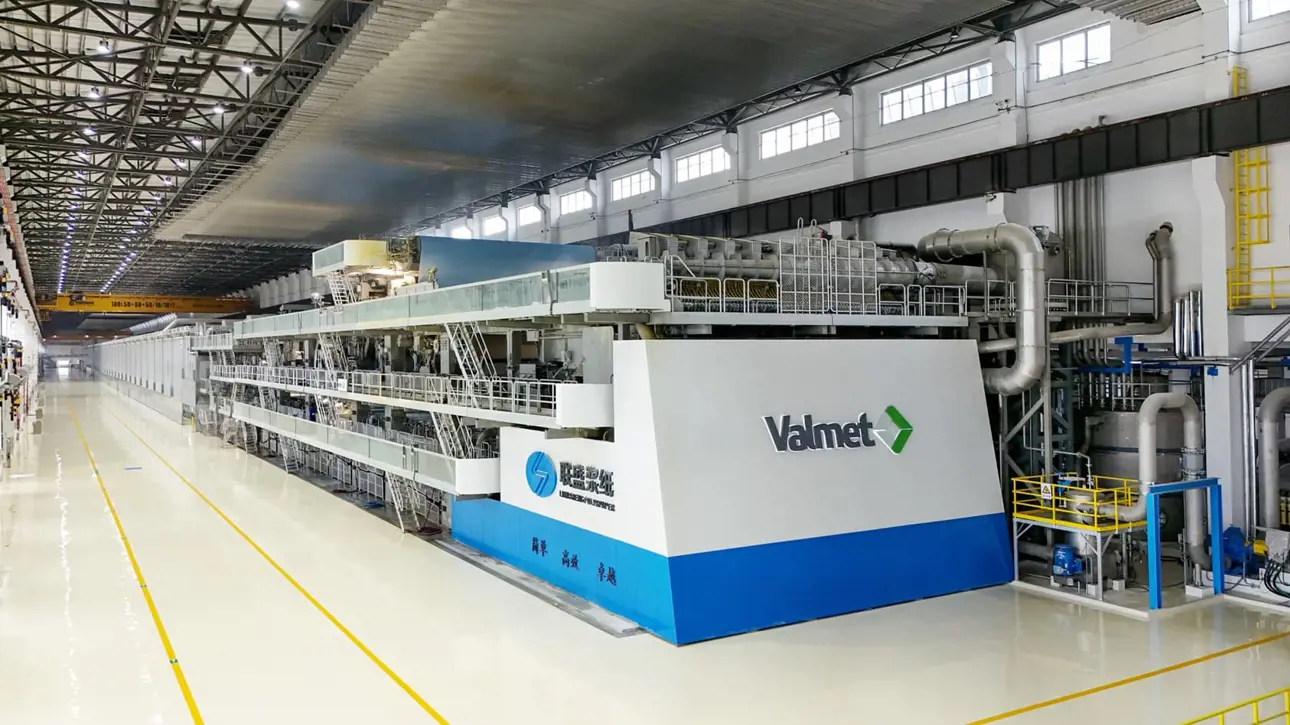
For Liansheng Pulp & Paper, BM 2 is a building block for expanding capacity, broadening the product portfolio, and improving operational efficiency. It is a step in the company’s integrated forestry-to-board growth strategy and its work to stay competitive in a demanding market.
Heavy-weight folding boxboard with BM 2
BM 2 is built for heavy-weight folding boxboard, a premium packaging grade. “The packaging paper market in China and globally is going through a period of structural adjustment,” says Huang Ju, Executive Vice President of Liansheng Pulp & Paper. “As industry recovers and packaging demand grows steadily, folding boxboard — as a high-end packaging grade — has good potential for stable, long-term development.”
At the Zhangzhou site, BM 2 works in a clear division of labor with BM 1, which is also a complete Valmet folding boxboard line concentrating on lighter grades. Pairing a machine producing notably heavier grades with a machine focusing on lighter grades lets Liansheng cover a wide product range through specialization rather than compromise.
A company that wants to grow and build more competitive products has to get specialization right. With each machine now focused on its own segment, we’ve moved past the earlier situation of one machine switching grades constantly and running at low efficiency.

Fast delivery phase, start-up, and ramp-up
BM 2 met its schedule and performance targets:
• First dryer cylinder was installed on October 18, 2024; machine started up on July 22, 2025 — under ten months, a fast build for a project of this type and magnitude.
• Nine hours from first stock to qualified product after start-up.
• The machine started up successfully at the first attempt.
• Design output and speed were reached within one month from start-up.
These results build on a long partnership. From the Longhai site to the Zhangzhou site, and from the Zhangzhou phase-one project to phase two, Liansheng and Valmet have worked together for close to twenty years.
“Phase one gave us confidence that Valmet can provide the best technology and a complete, whole-process solution as a reliable partner. Valmet’s ability to design the full production line, keep optimizing, and provide lifecycle service, together with fast response and problem-solving, is why we chose to work together again,” Huang Ju says.
A partnership that delivered
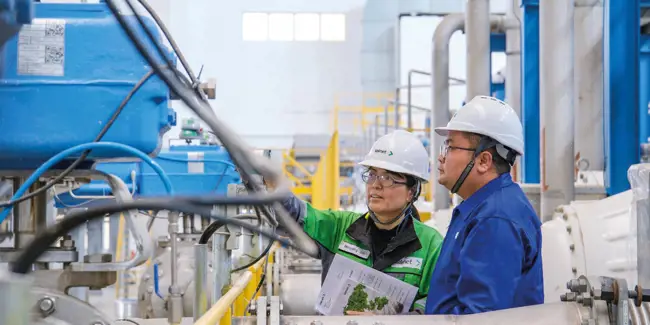
When asked what made BM 2 work well, Huang Ju points to close collaboration at every stage: thorough joint analysis and planning up front; early equipment delivery from Valmet that shortened the schedule; and well-coordinated installation and start-up. Valmet’s guidance during the delivery phase alone saved more than a month. Careful start-up support, Valmet specialists on site, phased training, and Liansheng’s own project experience delivered a smooth and successful start-up.
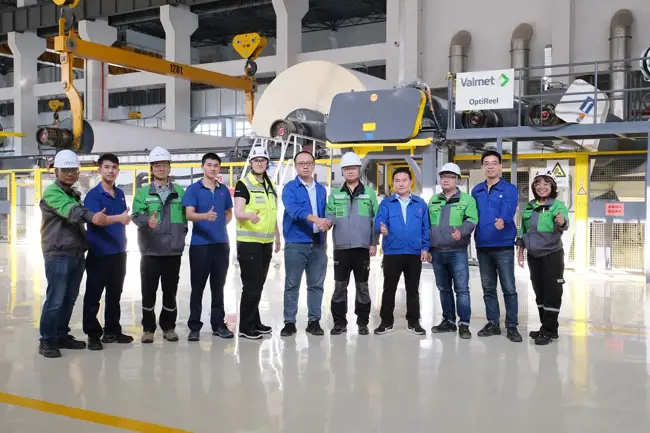
Valmet’s on-site installation and start-up team and the Liansheng project team both worked well. Throughout the delivery phase, both sides followed the principle of ‘no problem left overnight’, closing out every issue efficiently. That laid a solid foundation for orderly progress, an efficient start-up, and stable operation.
“During installation, Liansheng broke the plan down to the team and the individual level, with clear milestones and task lists; Valmet supported this by adjusting deliveries, so the site always had material to work with. When challenges came up, we reviewed them together and solved each technical and construction problem step by step,” Liu Jianwei, Senior Equipment Manager, Liansheng Pulp & Paper, explains.

Stable product quality from the first reel
BM 2 produces heavy-weight folding boxboard from 245 to 400 g/m², including full-weight, high-bulk, and ultra-high-bulk grades used in gift boxes, pharmaceutical and cosmetics packaging, mobile-phone boxes, and carrier bags. Product reached the market quickly after start-up, at the same stable quality level as BM 1.
Huang Ju says that Liansheng’s customers noted how quickly Liansheng stabilized quality. They didn’t expect BM 2 to reach such consistent quality so soon. Li Guowei adds that the product quality is stable and reliable, and it has good customer acceptance. Satisfied customers are the main goal for Liansheng Pulp & Paper.
Technology behind low energy use and stable quality
BM 2 is equipped with Valmet Conical Refiner Conflo units throughout the refining line. “Liansheng has always used Valmet Conical Refiner Conflo,” Li Guowei confirms. “Refining quality is stable and reliable and meets the demands of high-end folding boxboard production.”
The coating technology has performed very well in daily operation. “From cross-direction (CD) coat weight control to overall energy use and ease of operation, we’re satisfied,” Li Guowei says. “The coating air dryers reduce fire hazard and support safer working conditions. That gives us a solid basis for continuous, stable production.” The machine line includes four OptiCoat Jet coating stations with OptiDry Coat coating air dryers.
Li Guowei continues explaining that forming and sizing quality, and the finish after calendering, all meet Liansheng’s standards. Finished quality is under control, with no obvious anomalies. The winders have performed well too. “The OptiWin Drum two-drum winders are already running above the design capacity. The roll ends are neat, and the surface is smooth and scratch-free — which are what high-end folding boxboard grades require.”
Exceeding the design capacity in the second month improved operating efficiency and helped bring energy use and total cost down. BM 2 turned its capacity gain into a cost advantage and stronger competitiveness.’s
Overall energy use on BM 2 has come down significantly again from phase one — far beyond our expectations.

Empowering BM 2 with mill wide automation
Since start-up, Valmet’s automation solutions have delivered measurable benefits in operational efficiency, system reliability, and maintenance. First, a unified platform brings machine monitoring (Valmet DNA Machine Monitoring), machine controls (MCS), and quality controls (QCS) together in the Valmet DNA Automation System, which improves operator usability and operational efficiency. Second, system coordination has worked well, with smooth drive-speed synchronization and reliable communication with the distributed control system. Third, a network upgrade from traditional PROFIBUS to PROFINET, making this the first board machine in China to implement redundant PROFINET network, further strengthening reliability and long-term performance.
The results have been impressive. Quality control with Valmet IQ improved: the calender caliper control method was adjusted to control hard-nip caliper from the reel caliper measurement curve, addressing upstream issues. The web inspection system delivers high accuracy with 0.2 mm at sizing and 0.1 mm at the reel. The condition monitoring system detects bearing and gearbox faults early, supporting proactive maintenance and planned shutdowns. A capable customer automation team is in place after training, and stable VPN remote connectivity enables real-time fault monitoring, data analysis, and system optimization — supporting fast ramp-up, high-efficiency production of high-basis-weight folding boxboard.

Single-supplier scope for efficient execution and lifecycle support
Valmet supplied complete process technology, automation and control systems, and a comprehensive paper machine clothing and spare parts package for BM 2. “Having Valmet supply the whole process lowered coordination cost,” Li Guowei says. “Drawing on proven design experience, we could avoid problems already at the design stage. And because the spare parts package was shipped with the machine, we had supply on hand for the delivery phase, start-up, and later maintenance, which lowered operating risk.”
A Valmet lifecycle partnership means cooperation across the life of the investment — from early planning, project delivery, and start-up through continued performance improvement and long-term service, upgrades, and optimization. According to Huang Ju, the main advantage of the Valmet lifecycle partnership for Liansheng is the seamless cooperation during the whole lifecycle. In the early investment planning phase, Valmet gave useful advice that headed off issues at the source. During delivery and start-up, the Valmet team drew on experience from similar machines and kept optimizing so the equipment fits real operating conditions. In the operation phase, Valmet’s technical experts keep providing guidance to improve equipment performance.
Looking ahead, Huang Ju notes an expectation for the partnership: “In future development, we’d like Valmet to keep listening closely to production needs and, taking Liansheng’s own characteristics into account, pursue customized development and optimization — so new technology and equipment fit real operating conditions.”
Huang Ju sees four keys to staying competitive as a papermaking company. The first is scale, which makes products cost-competitive. The second is a fully integrated value chain, taking pulping, power, and forestry upstream to a high level. The third is good product quality. The fourth is cost-competitiveness: better cost at the same quality, and better quality at the same cost.
From forest cultivation to pulp and papermaking, and from low-carbon sourcing to high-end packaging, Liansheng Pulp & Paper uses the new BM 2 line as a link that connects the stages of its value chain more closely. Looking ahead, Valmet will continue to work with Liansheng — through ongoing technology development and lifecycle partnership — to lower operating cost, improve product quality, and raise efficiency.

Text: Dana Zhu, Elsa Sinjaga
Related articles and videos