Explore our journey

Valmet has over 225 years of industrial history

Valmet Journey 225 years

The journey of Valmet goes all the way back to the 1750s. It was then that a small shipyard was established in the Viapori fortress on the islands outside Helsinki. In the early 20th century it ended up under the ownership of the Finnish state and became part of Valmet. Tamfelt was established in 1797 and became one of the leading suppliers of technical textiles. These operations are now part of Valmet’s Services business line.

The story of Valmet

The story of Valmet documentary tells about Valmet’s 220 years of industrial history linked with events that occurred in the history of the world. It also describes the insights and solutions that modern-day Valmet has been built on. The documentary is a story about how to rise to the position of market leader and how significant the hard work of past generations is to the success of the present-day company.
From cloth making to high-tech

Valmet celebrated its 220 years of industrial history in 2017

The journey of Valmet can be woven from many different strings, looking into the history of different companies which today form Valmet Corporation. In Finland there are Tamfelt, Tampella and Valmet itself, in Sweden Götaverken, Karlstads Mekaniska Werkstad and Sunds bruk, and in North America Beloit and Dominion, just to mention a few.

Explore Valmet's timeline

The history of Valmet can be woven from many different strings, looking into the history of different companies which today form Valmet Corporation. In Finland there are Tamfelt, Tampella and Valmet itself, in Sweden Götaverken, Karlstads Mekaniska Werkstad and Sunds bruk, and in North America Beloit and Dominion, just to mention a few.

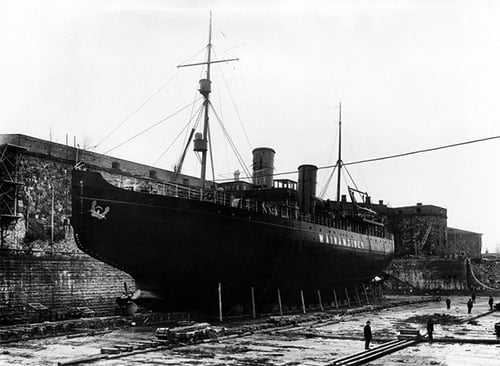
SS Wäinämöinen at Suomenlinna shipyard, Helsinki, 1759 - 1900.

Roots in the Viapori shipyard in Helsinki

1759 — 1900

A small shipyard was established in the Viapori (Suomenlinna) fortress on the islands outside Helsinki started operating in 1750s. In early 20th century the shipyard came to the ownership of the Finnish state and became part of the state metal factories, later Valmet.

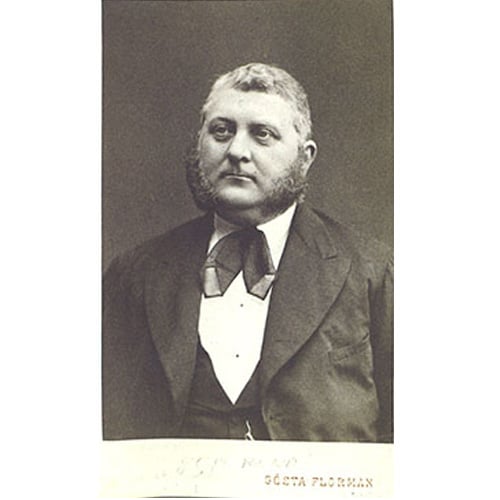
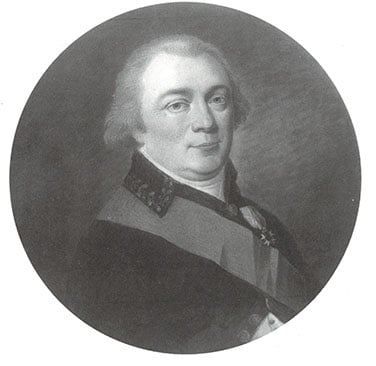
Ernst Gustav von Willebrand

Tamfelt’s felt business is born

1797 — 1800

The origins of Tamfelt go back to Jokioisten Verkatehdas, which was founded by the governor of Turku province, Ernst Gustav von Willebrand, with permission granted by the royal authorities in Stockholm on May 17th, 1797. Willebrand wanted to produce cloth using the new English machine method and the wool from the sheep of Jokioinen manor. At first he had 15 workers and two weaving looms. In 1798, the entire mill was burnt to the ground, but it was quickly rebuilt, and carding and weaving machines were in use as early as 1800. At that time, the mill was unique in Finland.

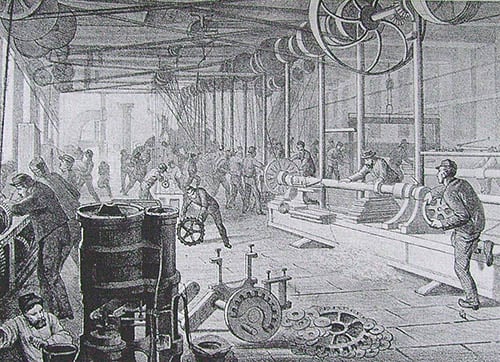
The image is an old black-and-white illustration depicting an industrial workshop in Göteborg, during the early era of mechanization. Numerous workers operate large belt-driven machinery powered by overhead shafts and pulleys. Gears, wheels, and mechanical components are scattered throughout the scene, capturing the busy and labor-intensive environment of a 19th-century manufacturing facility.

From marmalade to shipbuilding

1841

Götaverken, originally AB Keillers Mekaniska Verkstad, was founded in 1841 as a shipyard by a Scottish businessman Alexander Keiller in Göteborg, Sweden. Alexander Keiller’s mother was the creator of the famous Keiller's marmalade, which is believed to have been the first commercial brand of marmalade, originating in Dundee, Scotland.

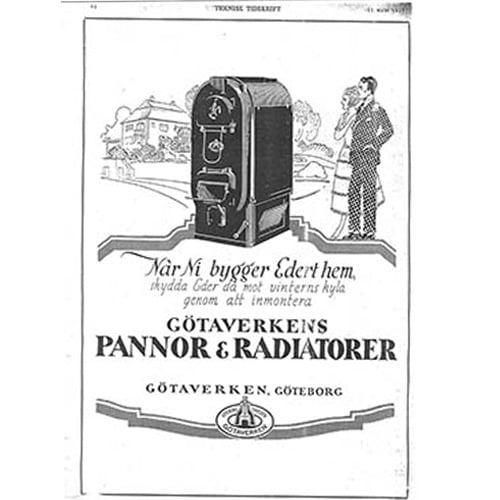
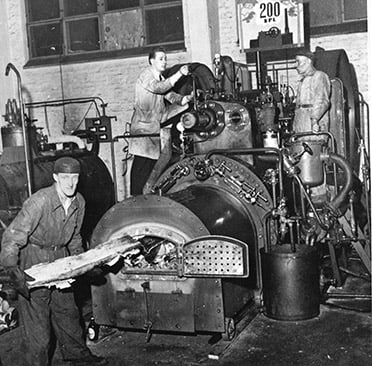
A vintage black-and-white advertisement features a drawing of a large heater or stove prominently in the center. To the right, a man in a long coat and hat appears to be warming his hands or smoking a pipe. Text in Swedish below the image promotes “Götaverkens Pannor & Radiatorer” (boilers and radiators) by Götaverken in Göteborg, emphasizing home heating solutions. The design and typography reflect an early 20th-century style.

1000 steam boilers from Götaverken

1850

As a steam propulsion became more common in 1850s, Götaverken started to design and manufacture boilers for steam production. During the coming years almost 1 000 steam boilers were produced in Göteborg. Among the customers were also Swedish and Finnish pulp mills.

Valmet Järvenpää unit’s roots in Helsinki, Osberg machine shop in the 1800s, 1854.

Järvenpää unit’s roots in Helsinki

1854

The roots of Valmet’s Järvenpää unit lie in Osberg’s machine shop founded in Sörnäinen, Helsinki in 1854. At the turn of the century, after merger with Siltarakennus Oy, the company’s name was changed to Kone ja Silta (Machine and Bridge). The production program included military equipment, steam boilers, bridges, pulp cookers, weighing scales, locks, household enamel ware and various other products.

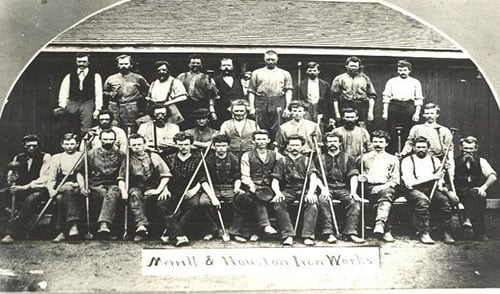
Merrill & Houston Iron Works group photo, 1858.

Beloit’s history began with water wheels

1858

In 1858 Orson E. Merrill came to Beloit in Wisconsin (USA) and started a foundry at 637 Third Street. Next year he took in a partner, George Houston. The company’s, known as Merrill and Houston Iron Works, principal product was a water wheel developed by Houston, but the firm could also supply horseshoe nails, iron and steel castings, saws, augurs, spokes, and a variety of iron products. In 1860 Merrill’s brother asked Merrill and Houston to make parts for his paper machine. By 1862 Merrill and Houston was producing complete paper machines, building four machines the first year.

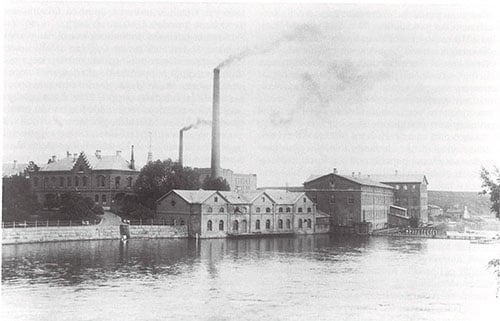
Tampereen Verkatehdas building photo before 1918.

Tampereen Verkatehdas Oy is born

1859 — 1863

Jokioinen Verkatehdas was hindered by the lack of water. To ensure the water supply the mill was moved from Jokioinen to the Tammerkoski rapids in Tampere. Production started in 1859. The mill was named A.I Frietsch & Co., but was commonly referred to as "Tampereen Verkatehdas". The machines were moved from Jokioinen and many of the workers relocated, too. In 1863 Frietsch went bankrupt.The mill was taken over by the Bank of Finland and was soon sold to Frans von Frenckell, A.W. Wahren, Nils Procopé, August Borgström and Carl Zuhr. This was the foundation of Tampereen Verkatehdas Osakeyhtiö (Tampere woollen and worsted mill).

Gustaf Adolf Andersson

From church bells to locomotives

1860 — 1880

Karlstads Mekaniska Werkstad (KMW), a metal workshop, was founded by Gustav Adolf Andersson in 1860 in Karlstad, Sweden. In 1865, after the conflagration of Karlstad, the company got a major order: casting of new church bells for the Karlstad cathedral. The expansion of the railway network in Sweden opened new markets for locomotive, carriage and railroad equipment producers KMW being one of the companies benefitting from this development.

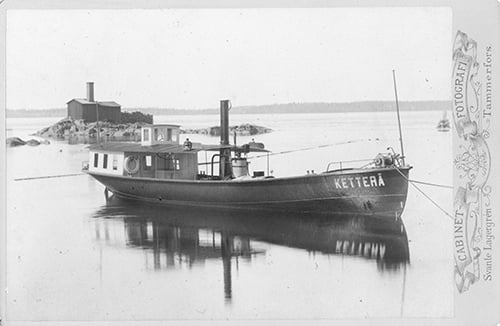
A steam ship built by Tampella, ''Ketterä''.

Tampella’s long roots in Tampere

1861

Tampella, originally Tammerfors Linne- & Jern-Manufaktur Aktie-Bolag, was founded in 1861 through a merger of a linen factory Tampereen Pellavakehräämö and a metal workshop Tampereen konepaja which both had been established in 1856. In early years the company manufactured linen clothes, ships, water turbines, pulp grinders and steam engines.

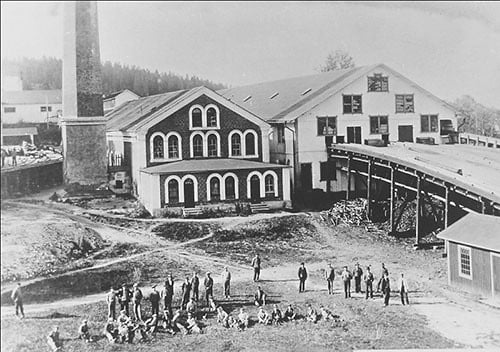
Sunds Bruk, Boiler House, 1868.

Sunds Bruk founded

1868

Sunds Bruk, the predecessor of Sunds Defibrator Industries AB, was established in the village of Sund, Sweden in 1868 by Erik Jan Hammarberg, a son of a blacksmith, with the financial support from Anders Petter Hedberg, Lars Johan Hierta, who was a well-known politician, publicist and businessman, and Bernhard Almquist.

Beloit Iron Works drawing room in 1885.

Beloit Iron Works is born

1885

In 1885, four employees of Merrill and Houston formed a new company, Beloit Iron Works. T. Organizer and president of Beloit Iron Works was Fred Messer, who had been superintendent at Merrill and Houston. The company leased the old Merrill and Houston plant from its new owner for its operations, and hired ten employees.

Hard times for Tampereen Verkatehdas

1888 — 1940

In 1888, the Tampereen Verkatehdas mill was destroyed by fire, one of the biggest in the history of Tampere. The whole town came out that summer night to see the main building consumed in just a few hours. The new mill was, however, built quickly and production re-started after only a short break. The next year, the mill was damaged by a flood. Politics then intervened to cut off trade with Russia. Finland became independent and in the battle of Tampere, in 1918, the company's raw material store burned down. In 1936, a new building was constructed specifically to meet the needs of machine felt production. The 1940s brought war once again. There was a manpower shortage and little fuel. Air raids disrupted normal life. On March 2, 1940, the mill was hit by 16 bombs.

Karhula machine shop, 1890 - 1915

Karhula machine shop

1890 — 1915

The industrialist William Ruth established a machine shop in Karhula in 1890 to take care of the repairs and service of the machinery in his sawmills and groundwood plant. This was the start of the Karhula machine shop, which A. Ahlström Oy acquired in 1915.

First KMW paper machine delivered to Mänttä, 1891 - 1895.

First KMW paper machine delivered to Mänttä

1891 — 1895

In 1891 KMW delivers its first paper machine to Mänttä paper mill in Finland after long negotiations with Gustaf Adolf Serlachius. Before the machine started its journey to Finland it was presented thoroughly to the Swedish press by engineer Wilhelm Hesslin. In 1895 the company manufactures its first Yankee machine with a diameter of 2,400 mm. The development and construction work was led by Hesslin.

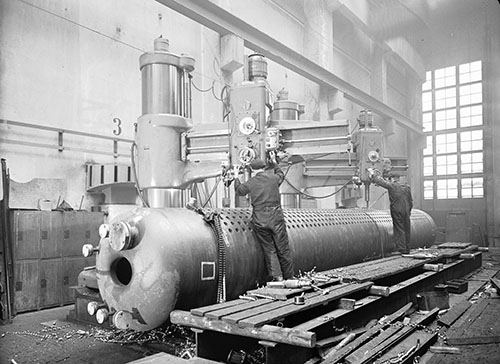
A historical black-and-white photograph shows two Tampella mechanics operating a large industrial drilling machine on a cylindrical metal component, likely a boiler or pressure vessel. The workshop is spacious with high ceilings, tall windows providing natural light, and metal shavings scattered on the floor, indicating active heavy manufacturing or machining work.

Tampella focuses on boilers

1930 — 1967

During 1930s Tampella started to manufacture power boilers and recovery boilers. In 1967 Tampella presented its first large-scale industrial multifuel power boiler to the market.

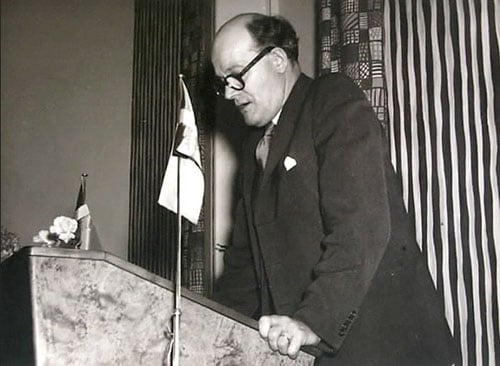
Gustaf Gidlöf at an inauguration in 1953.

Gustaf Gidlöf made his mark on Sunds

1933 — 1957

Gustaf Gidlöf was born in 1899. He started at Sunds Bruk Verkstäder & Slip as a 13 year old. Eventually he became a draftsman and later on a skilled designer. In 1933 he became the local manager. He was manager until 1957 when he stepped down due to illness. Gustaf Gidlöf was a powerful and foresighted person that has contributed a lot to the development of Sunds. The road the company is located on is today named Gustaf Gidlöfs väg after him.

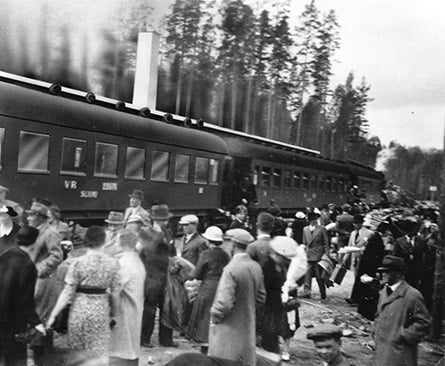
A historical black-and-white photograph depicts a large crowd of people gathered near a stationary passenger train. The scene shows men and women dressed in early-to-mid 20th-century attire, including hats and coats, suggesting a significant public event or travel occasion. Tall trees line the background, indicating a rural or forested setting. Located in Rautpohja, 1938.

Rautpohja operations begin

1938

The Valtion Tykkitehdas artillery works was established in 1936 when the State of Finland decided to move the repair shops of Armory 1 from Helsinki to Jyväskylä. The move of the works took place over the course of one night on a military train with two passenger cars and 40 freight cars full of gear. About 75 families travelled into the unknown on the train that arrived at the station yard of the works area on the morning of June 1, 1938. Valmet was created in 1951 on the foundations of the artillery works.

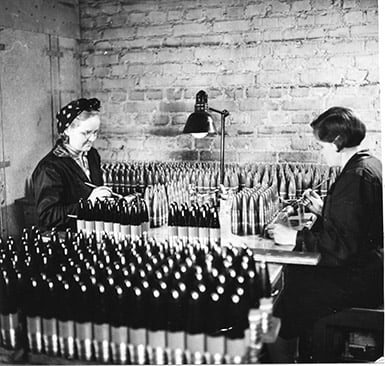
Artillery works at Rautpohja 1938 — 1944, two people working

Artillery works at Rautpohja

1938 — 1944

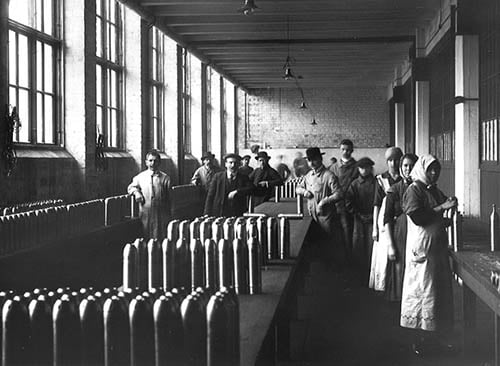
The main task of Valtion Tykkitehdas was to manufacture artillery pieces and take care of their repairs and spare parts. The production of shell cases and fuses started later. Due to the prevalent shortage of labor, the factory also employed women. The photo shows painting of 37 mm anti-tank shells at the artillery works in 1942.

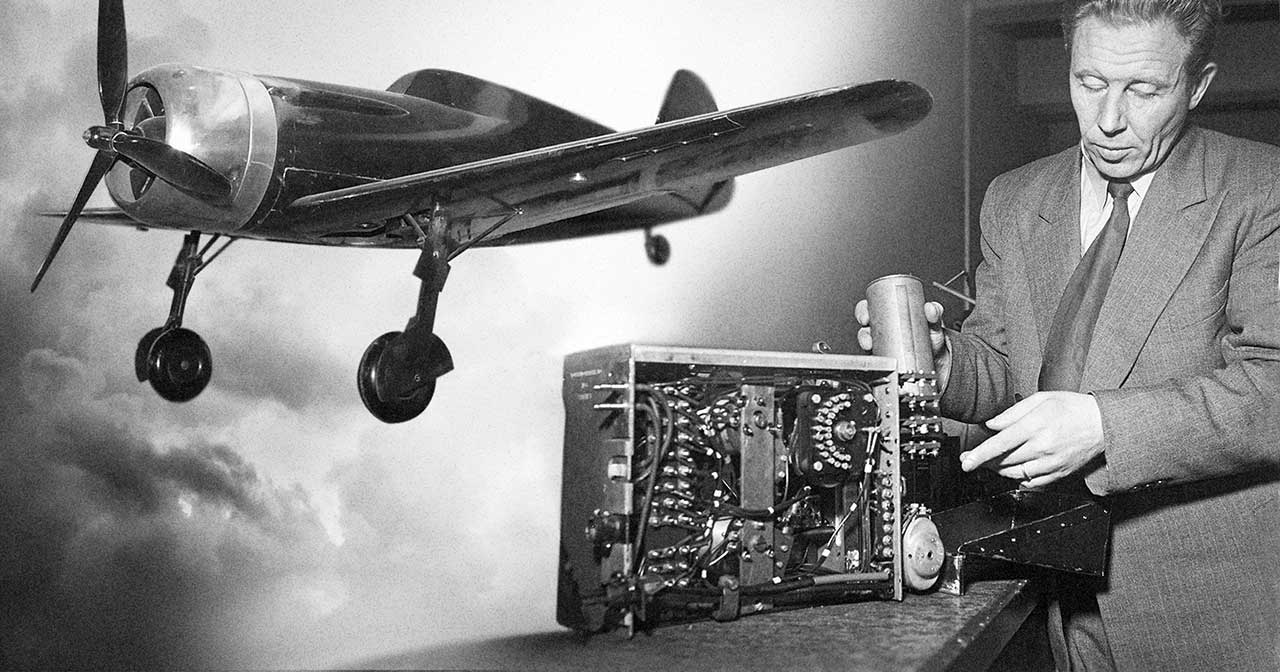
A black-and-white historical image features a split scene: on the left, a propeller-driven airplane is flying through the clouds, and on the right, Esko Halme in a suit is handling an black box device filled with wires and components, possibly early aviation or radio technology equipment. The juxtaposition suggests innovation in aviation and electronics.

A black box designed by Valtion Lentokonetehdas

1942

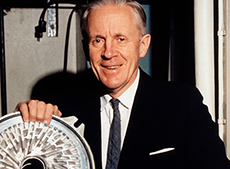
Safety first! Did you know that the roots of Valmet’s automation business are in aviation? One of our very first innovations helped improve aviation safety: a black box designed by Valtion Lentokonetehdas back in 1942. Valtion Lentokonetehdas became a part of Valtion Metallitehtaat in 1945, re-baptised Valmet in 1951. Safety continues to be fundamentally important to us still today. In the picture, test pilot Esko Halme with the black box called “Mata Hari” in 1953.

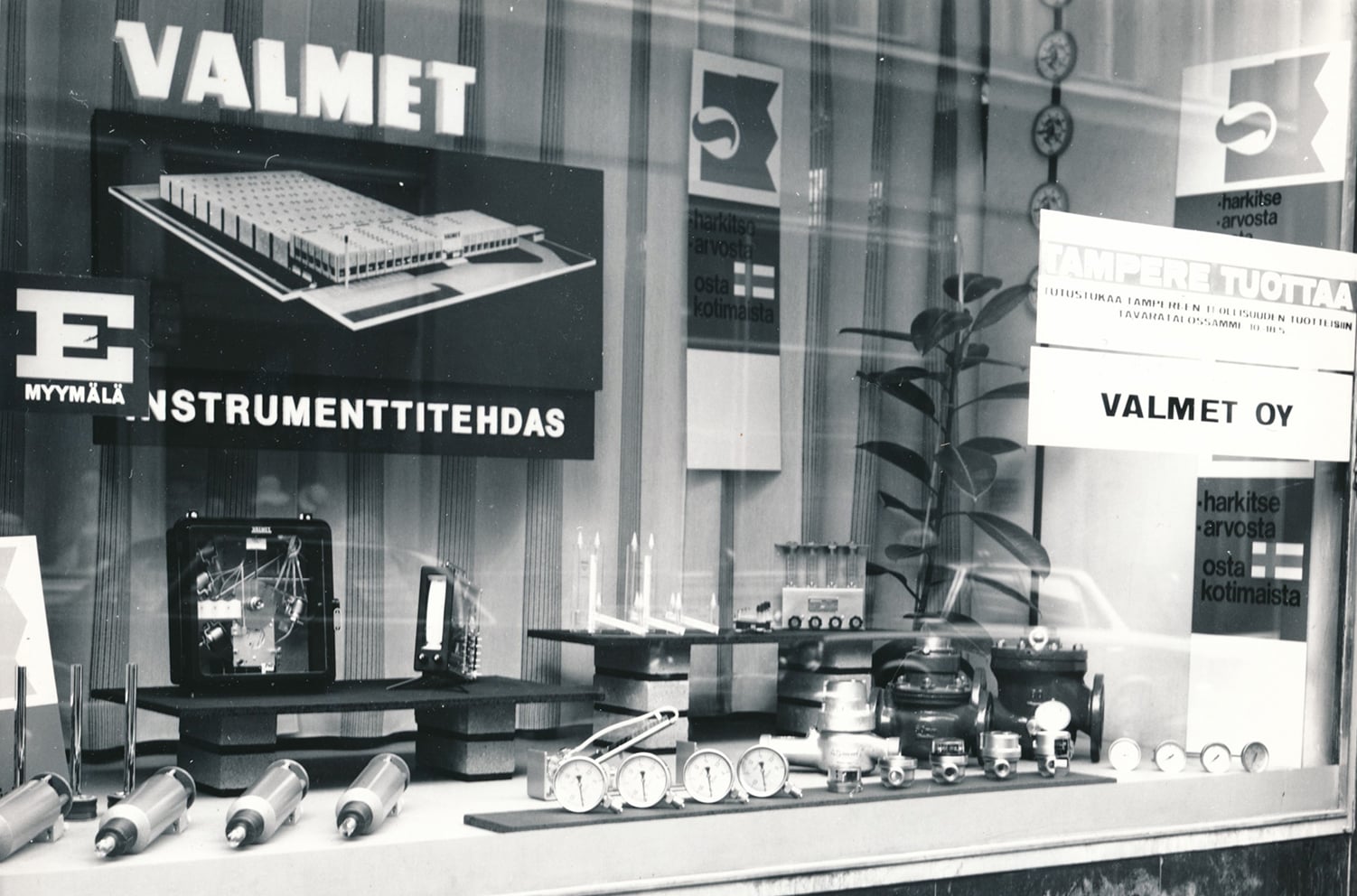
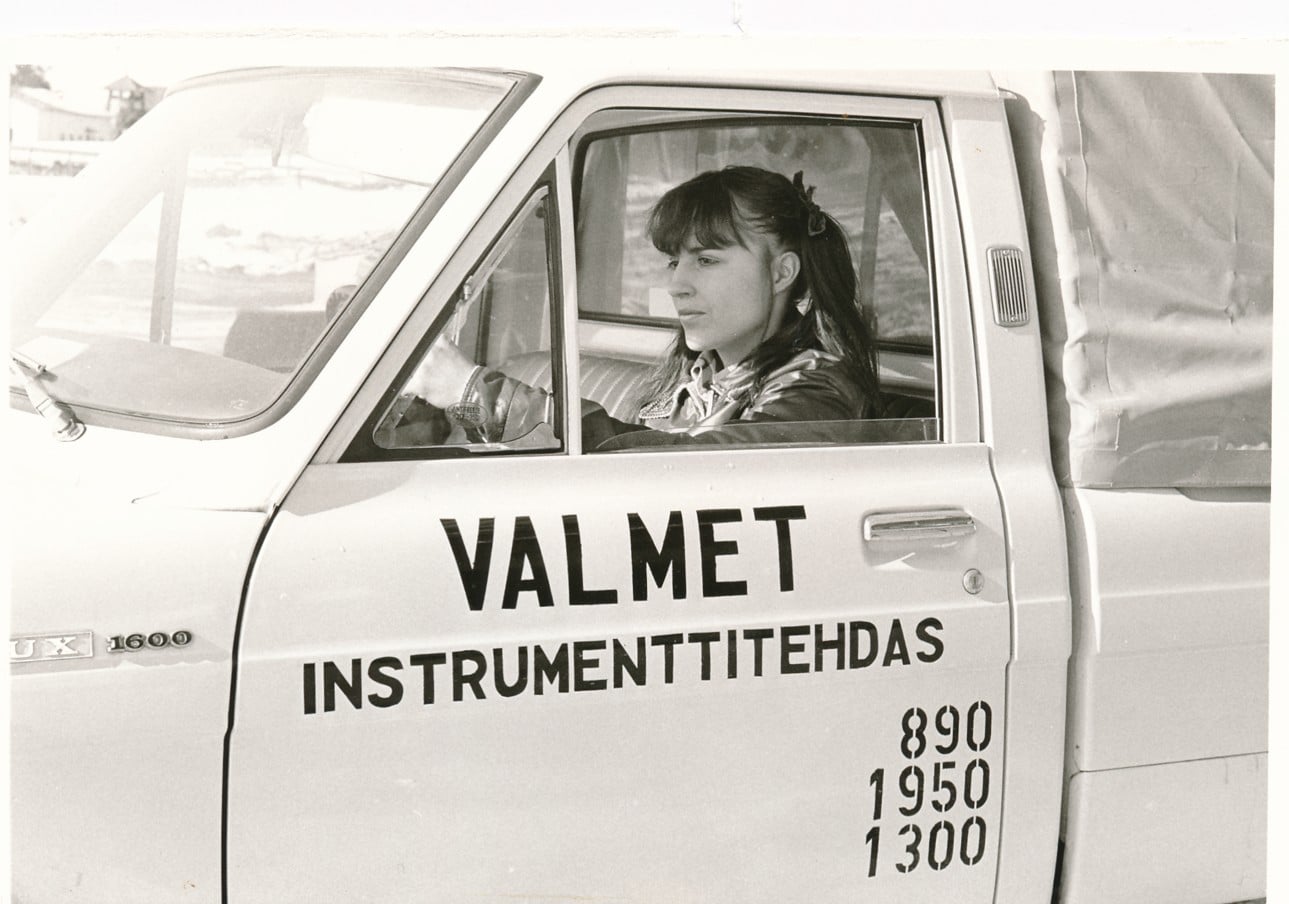
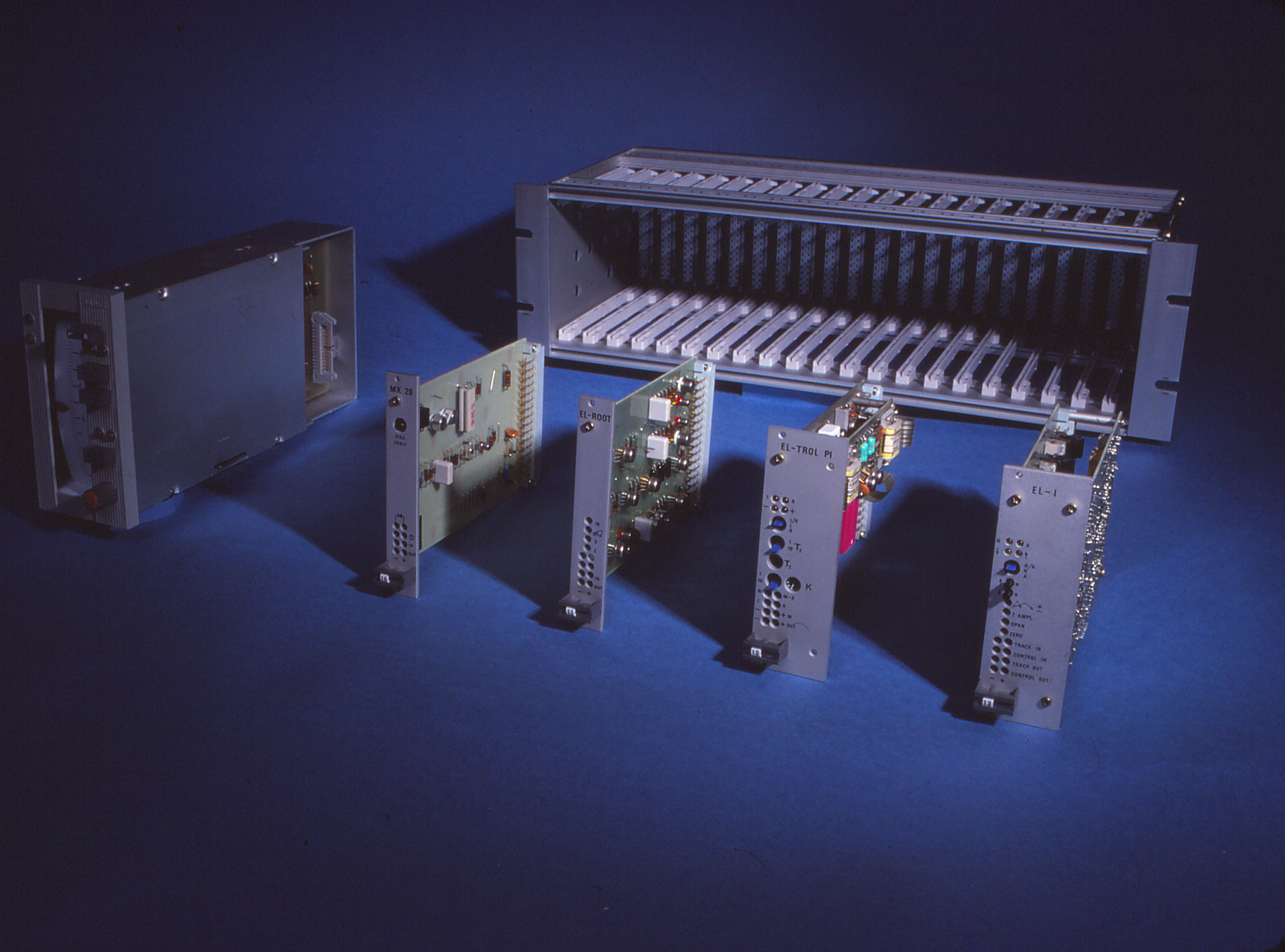
After the war, the aviation business transformed into multiple manufacturing businesses - including instrumentation. In 1973, the instrumentation business was separated to become its own company called Valmet Oy Instrumenttitehdas, later known as Metso Automation and Valmet Automation – Valmet’s current Automation Systems Business Line.

Test run of a locomobile in Rautpohja in 1952.

War reparations

1944 — 1952

After the war ended, the reference to artillery was removed from the factory's name; it became the Rautpohja works of Valtion Metallitehtaat. The works participated in the war reparations production, manufacturing log lifts, log bundling equipment, locomobiles and bandsaws, among other things.

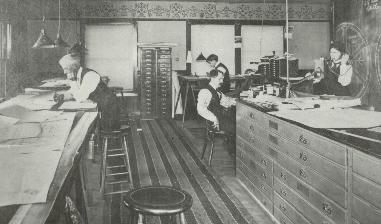
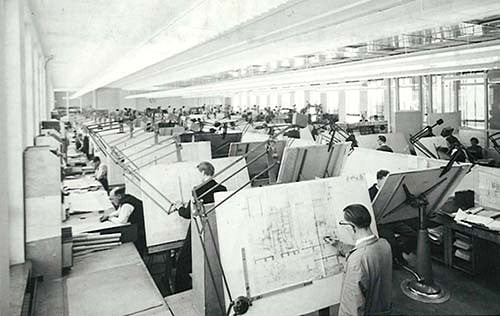
A historical black-and-white photograph shows a large drafting office filled with rows of drafting tables and individuals working on technical drawings. The space is well-lit with tall windows and overhead lighting, and the workers appear focused on detailed architectural or engineering projects.

Kone ja Silta paper machines to all over the world

1945 — 1959

The first paper machines made by Kone ja Silta were delivered from Finland to the Soviet Union in connection with the war compensations in 1945-1952. Kone ja Silta received its first paper machine order from Czechoslovakia in 1949 with a 3-year delivery time. From the beginning of 1950s paper machines started to be an important part of the production program. In the 50s, paper machines were delivered to all over the world, including China, Switzerland, Soviet Union, France, Finland, among others.

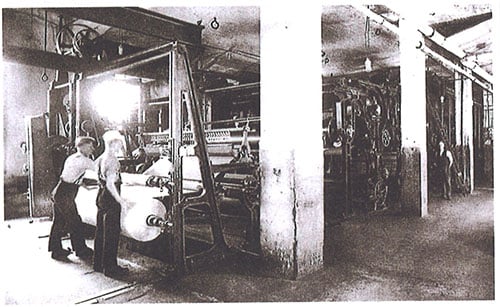
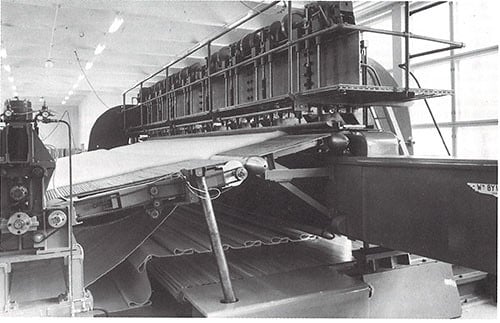
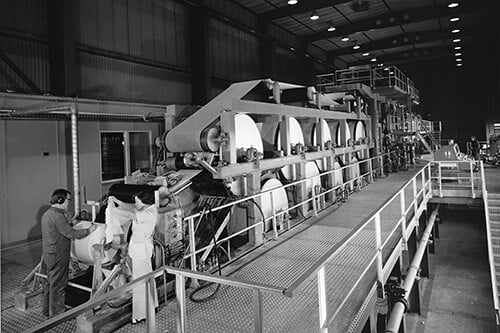
A black-and-white photograph shows a large needling machine in operation inside a well-lit factory. The equipment features multiple rollers and a wide sheet of paper being processed through the system. Elevated platforms with mechanical components run along the top of the machine, indicating complex manufacturing machinery used in paper production.

Tampereen Verkatehdas focuses on felts

1950 — 1965

The machine felt division had always lived in the shadow of the woolen mill. But, in the 1950s, when the woolen industry encountered many difficulties, the machine felt division took on the role of savior. The felt mill flourished and for the first time, in 1960, its sales exceeded those of the woolen mill. This development was due to the declining market situation in the woolen industry combined with strong growth in the Finnish paper industry and the successful export of machine felts. Exports started in 1956. The production of filter fabrics began in 1965, and from then on the company focused on technical textiles.

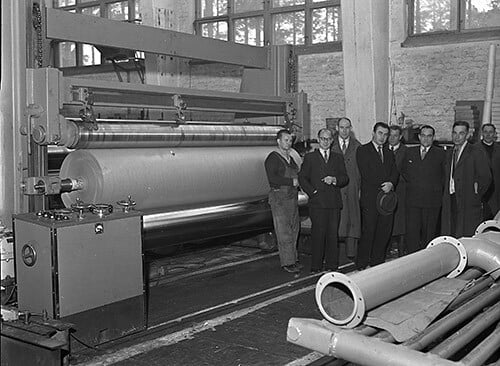
A black-and-white photograph depicts a group of men, some in suits and others in work attire, standing beside a large industrial paper machine at Rautpohja, with massive rollers inside a factory setting. The machine appears to be producing or processing a wide roll of paper, and additional large cylindrical components are visible in the foreground, indicating heavy manufacturing equipment.

Developing the Rautpohja works

1952

The last war reparations product of the works, a winder, was handed over in the Rautpohja machine hall in 1952. After the reparations were completed, the factory concentrated on developing its own production. The earlier artillery works was turned into a heavy machine workshop that initially had a wide product range.

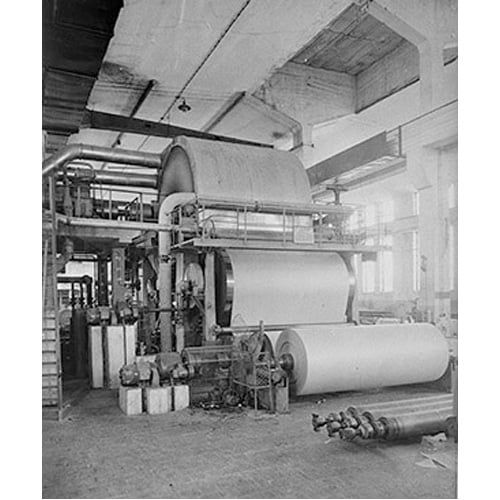
A historical black-and-white photograph shows a large Yankee paper machine inside a factory. The machine has multiple rollers and is producing a wide sheet of paper wound into large rolls. Mechanical components and spare parts are visible on the floor, and the high-ceilinged space has windows providing natural light, typical of early 20th-century manufacturing facilities.

Paper machines from Rautpohja

1953

The first two paper machines manufactured at Rautpohja, a Yankee and a sack paper machine, were delivered to Poland in 1953. Paper machines became the workshop’s main focus in the 1960s, and Valmet became an internationally significant company in the mid-1960s after delivering several machines to the world's leading paper industry countries.

Simpele machine is in the test installation stage in the Rautpohja machine hall in 1954.

Delivery to Simpele mill

1954

The first Valmet paper machine was started up at the Simpele mill of Yhtyneet Paperitehtaat in 1954. The machine with a working width of 2,400 mm had many innovative technical solutions that were not in use at other paper mills in Finland at the time.

Paper machine production at Rautpohja

1955

Glimpses of paper machine production at Valmet Rautpohja works. This film was done together with Suomi Filmi in 1955. The film is in Finnish.

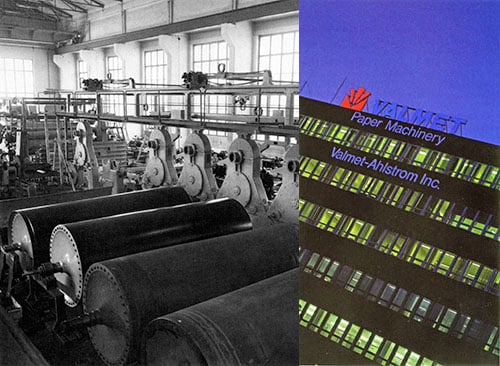
On the left, a black-and-white photo of an industrial paper machine inside a factory shows multiple large rollers and complex mechanical systems, typical of heavy paper production equipment. On the right, a color photo of a high-rise office building at night features the illuminated Valmet logo along with the text "Paper Machinery" and "Valmet-Ahlstrom Inc." against a dark blue sky, indicating the corporate identity and location of the company.
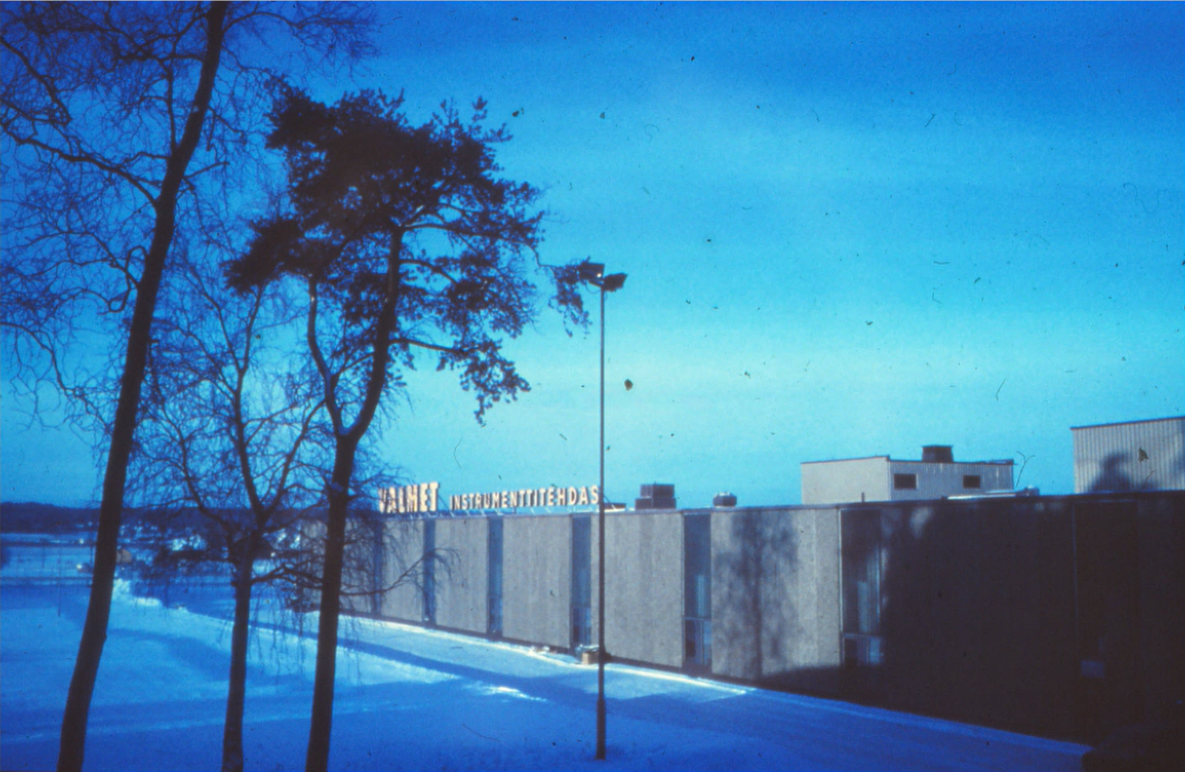
Valmet-Ahlström

1959 — 1987

The production of the Karhula machine shop included, among other things, machinery for the wood processing industry. The first paper machine was delivered from Karhula in 1948. In the summer of 1987, Valmet Paperikoneet Oy and A. Ahlström Oy agreed on transferring the paper machine operations of the Karhula machine shop to the newly established Valmet-Ahlström Oy. The company manufactured small and medium-sized paper machines, multi-layer board machines and pulp-drying machines. Operations in Karhula continued until 2005.

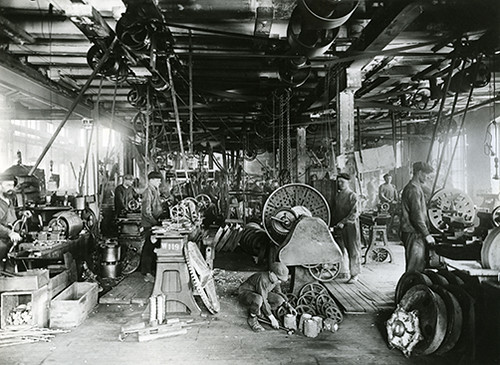
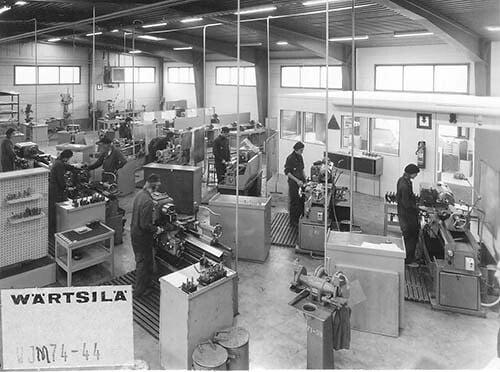
A historical black-and-white photograph shows a machine workshop with multiple workers operating lathes and other metalworking machines. The large, organized space has high windows for natural light and partitioned sections, suggesting a structured manufacturing environment. A sign reading “Wärtsilä” is visible in the foreground, indicating the company's association with the facility.

Kone ja Silta changes to Wärtsilä

1965 — 1970

Wärtsilä had bought Kone ja Silta in 1936, but is wasn’t until 1965 when the factory name was changed to Oy Wärtsilä Ab Helsinki factory. In 1970 the factory moved from Helsinki to the current premises in Järvenpää. Also the Wärtsilä machinery school moved to Järvenpää in the early 1970s.

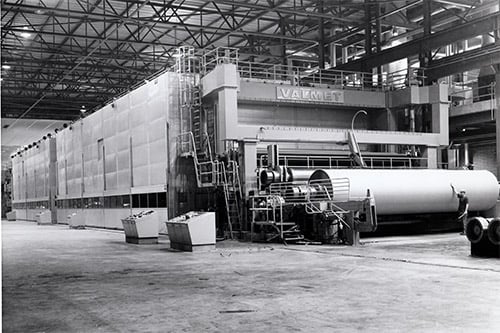
A black-and-white photograph depicts a massive industrial paper machine inside a spacious factory. The large structure features multiple rollers and control panels on the side, with a huge roll of finished paper being processed. The word “Valmet” is prominently visible on the upper section of the machine, indicating the manufacturer.

From Rautpohja to North America

1972

After the North American market opened at the end of the 1960s, Valmet had reached all potential paper machine market areas. At its time, the machine delivered to Continental Group Inc. in 1972 was the world's widest machine and had the highest output. Its working width was 9.3 meters.

A black-and-white photograph shows a large industrial pilot machine with multiple rollers in operation. A worker wearing protective gear is handling the material at the beginning or end of the machine, which is set within a spacious, high-ceilinged factory environment. Walkways with railings run alongside the machine for operational access.

Technology development with pilot machines

1977

The high technical level of Valmet's paper machines was based on extensive research. The one-meter-wide pilot machine of the pilot plant completed in 1977 was used to test new solutions for increasing the speed of paper machines and improving the paper quality. The pilot paper machine was also used to test the suitability of new raw materials, such as sugar cane, for paper production. In 1996, another pilot paper machine was constructed in Rautpohja.

Arne Asplund

How is Arne Asplund connected to Valmet?

1979

Arne Asplund invented the Defibrator pulping refiner and the defibrator method for pulping wooden chips in 1930s. The company AB Defibrator was founded based on Asplund's invention. AB Defibrator was merged with Sunds AB to form Sunds Defibrator in 1979. The annual Arne Asplund Mechanical Pulping Award was established in 1985 to commemorate Asplund’s contributions to the pulp and paper industry. Sunds Defibrator Industries AB came under Rauma-Repola’s ownership in stages during 1988-1991 and later part of Valmet-Rauma.

Valmet Service Technology Center at Rautpohja

Service Technology Center at Rautpohja

1980

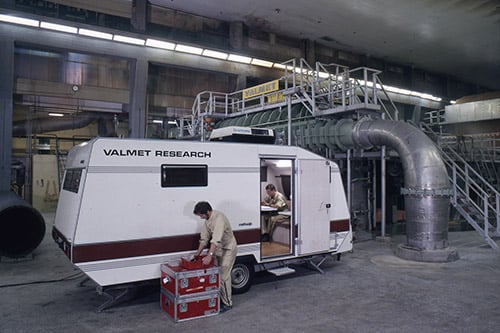
Mobile research carriages were already a part of Rautpohja's research equipment in the 1970s. The carriage was taken to an operating paper machine, and measuring sensors were connected to the machine. The results were used to troubleshoot process problems in paper machines. The Service business was started in the 1980s based on operating models like these. The conditions for service operations improved with the Service Technology Center that was completed in 1989. The service center also handled large-scale roll modernizations and demanding special coating for rolls. Around-the-clock standby operations were also established.

Tamfelt plant in Tampere, Tampereen verkatehdas

Tampereen Verkatehdas becomes Tamfelt

1981 — 1984

Tampereen Verkatehdas Oy - Tammerfors Klädesfabriks Ab was listed in the Helsinki stock exchange in 1942. The old company name became distinctly misleading as well as old fashioned as the company focused on machine felts and technical textiles. In 1981 the name was changed to Tamfelt Corp. In 1984 Tamfelt acquired a forming fabric manufacturer, Viira Oy, and became a full line supplier of paper machine clothing (PMC products).

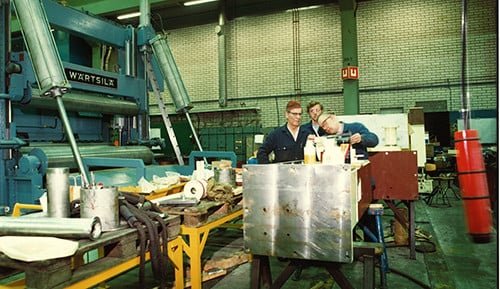
Järvenpää workshop in 1983. The image shows three men working together in an industrial workshop, surrounded by heavy machinery, tools, and equipment parts. A large blue machine labeled “Wärtsilä” is visible on the left side, indicating the manufacturer. The workers appear to be inspecting or assembling components on a metal workbench in a spacious factory setting.

Järvenpää focuses in finishing

1983

In the 1980s, the Järvenpää factory was turned from mixed production to a specialized workshop with main focus on paper finishing machines and machines for pulp production. The company’s internationalization was started in 1983 by acquiring the finishing machine manufacturer, Appleton Machine Company in the USA.

Dominion becomes part of Valmet

1984

In 1984, Valmet acquired a majority of shares in Canadian Dominion Engineering Works. Valmet owned 65% of the new Valmet-Dominion, Inc. The new company opened new opportunities for Valmet's paper machine business and secured more effective operations on the North American market, which had become very important to Valmet as a whole.

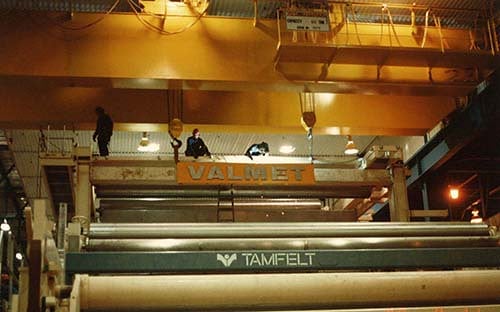
The image shows a large industrial setting with heavy machinery and overhead cranes. A prominent orange crane marked "VALMET" is visible at the top, while large rollers and components labeled "TAMFELT" occupy the lower part of the scene. Several workers are standing on the overhead structure, indicating maintenance or installation activities in a paper or material processing facility.

Wärtsilä Järvenpää into Valmet

1986

Wärtsilä Järvenpää factory become part of Valmet in 1986. The background for this acquisition was the product rationalization agreement between Wärtsilä and Valmet. The roots of the agreement date back to a product split agreement between Tampella, Valmet, Wärtsilä in 1969. In 1986 Wärtsilä and Valmet also rearranged their shipyard ownerships.

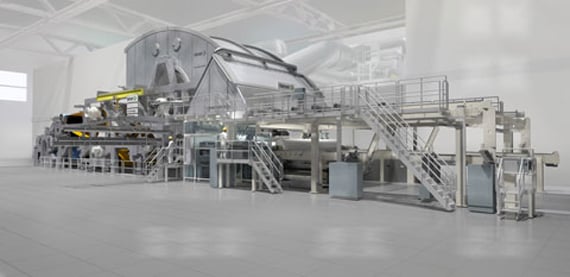
 The image shows a modern, large-scale industrial paper or tissue production machine inside a bright, spacious facility. The equipment consists of multiple connected sections with rollers, metallic enclosures, and elevated platforms with staircases for operational access, indicating a highly automated manufacturing process.

KMW becomes part of Valmet

1986

Valmet acquired KMW’s paper machine production operations in 1986. Since then Karlstad has been established as Valmet’s technology center and main location for tissue machines business and innovation. Some milestones in the development have been the TAD-machine developed in 1980s, DCT-concept launched in 2004 and NTT-concept launched in 2008.

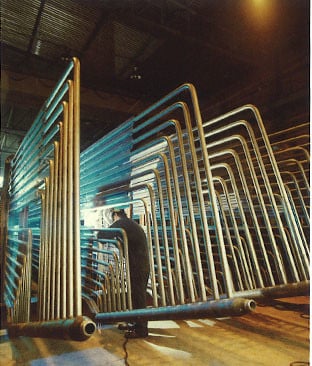
CYMIC Boiler elements at Tampella factory, 1987.

CYMIC boilers are born

1989 — 1992

Tampella broadened its circulation fluidized bed boiler technology know-how through the acquisition of the North American Dorr-Oliver’s boiler operations in 1989. In 1992 Tampella presented its first CYMIC boiler based on its own innovation within circulating fluidized bed boiler technology.

Valmet DNAe wins Automation Award for its Innovation

May 13, 2025

Valmet was honored with the 2025 Automation Award from the Finnish Society of Automation for its Valmet DNAe Distributed Control System (DCS). This award recognizes the significant innovation and industry leadership demonstrated by the development and launch of Valmet DNAe.

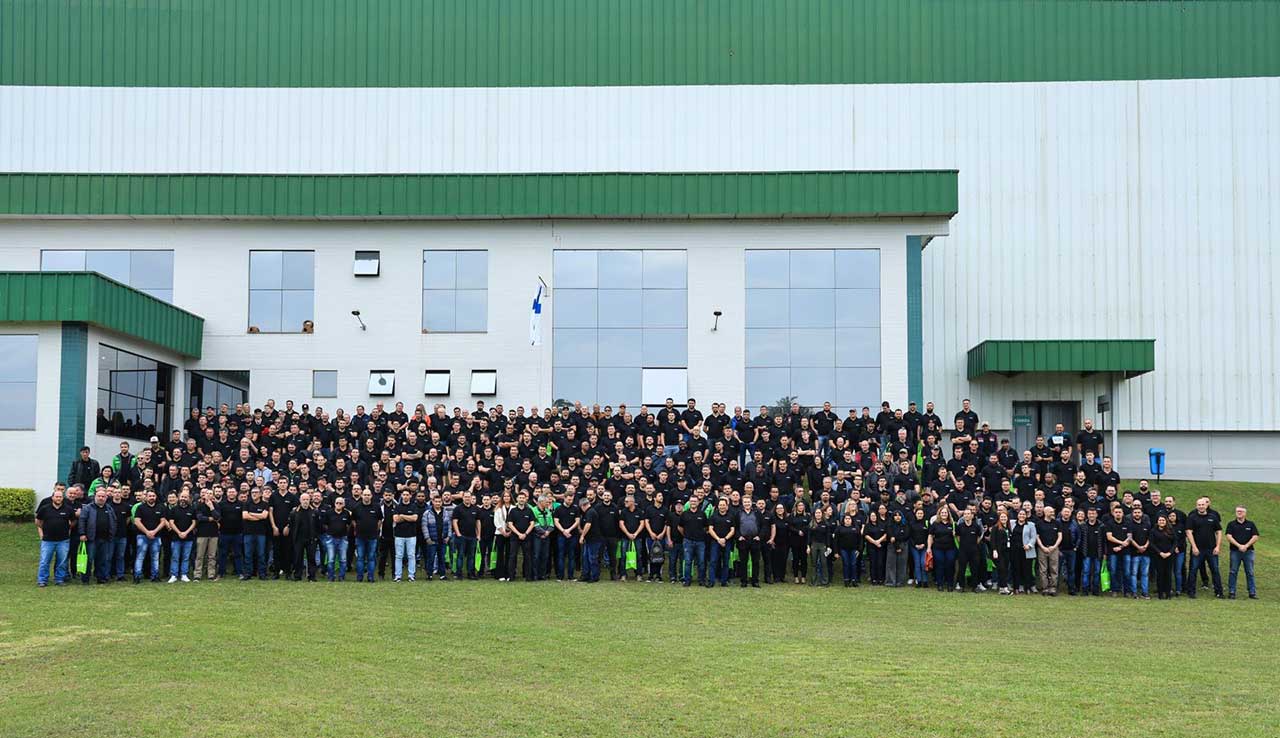
Valmet acquiring Demuth on day 1, team gathered outside for a group picture

The acquisition of Demuth

Aug 2,2024

On August 2, 2024, Valmet completed the acquisition of Demuth, a provider of wood handling technology and services in South America. This acquisition significantly strengthens Valmet’s wood handling technology offering and services presence in South America.

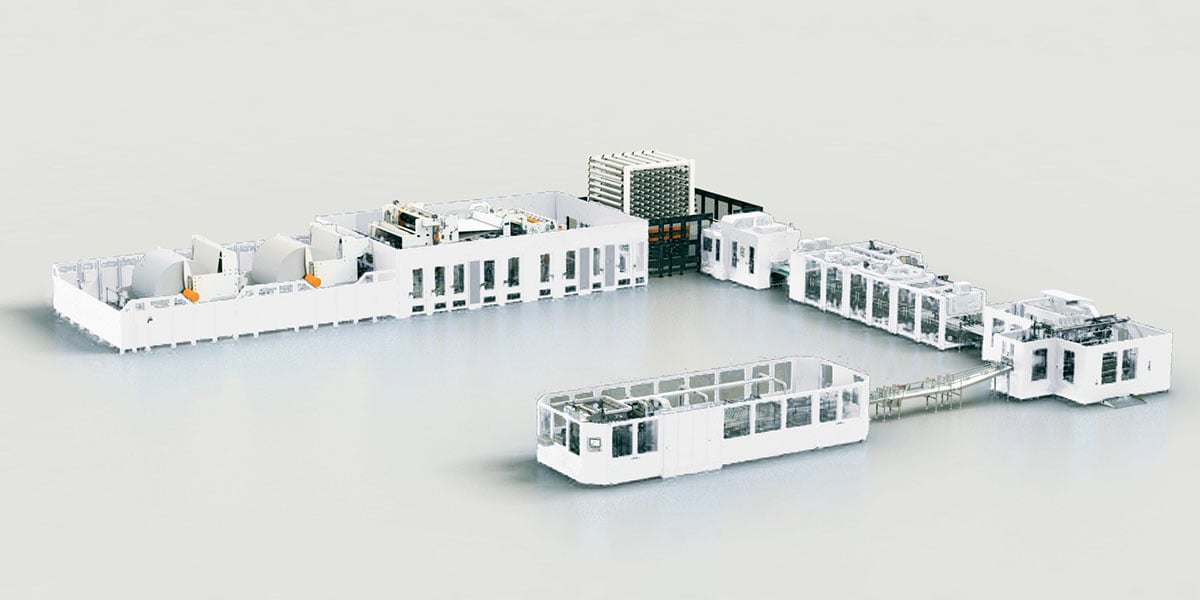
A 3D rendered model of an industrial production line or facility is displayed, consisting of multiple interconnected white structures and machines. The layout is arranged in an L-shape, with enclosed sections suggesting automated equipment and processing areas. The design appears clean and modern, likely representing a manufacturing or packaging system.

The acquisition of Körber’s Business Area Tissue

2023

On July 7, 2023, Valmet entered into an agreement to acquire Körber Group’s Business Area Tissue. The Business Area Tissue specializes in innovative converting and packaging technologies and services for the tissue industry. On November 3, 2023, the acquisition was completed. By combining the complementary offering and competences of Valmet and the acquired business, Valmet creates the markets’ widest technology, automation and services offering for the growing tissue industry covering the entire tissue value chain from fiber to finished products.

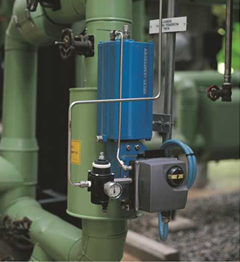
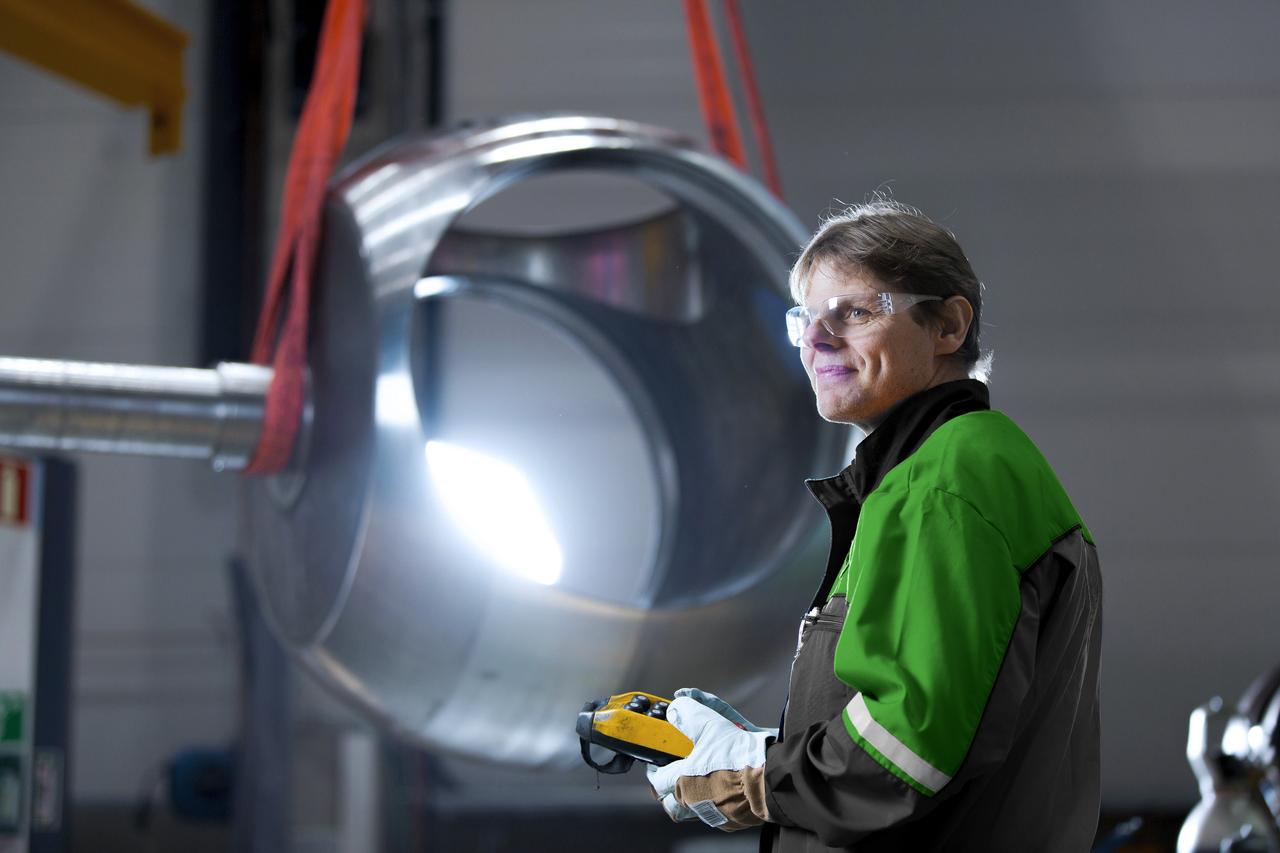
A Valmet worker wearing a white safety helmet and a high-visibility jacket is inspecting or operating a section of industrial piping and machinery. The equipment features multiple blue valves, metal pipes, and control elements, indicating a controlled processing or manufacturing environment.

Merger of Valmet and Neles

2022

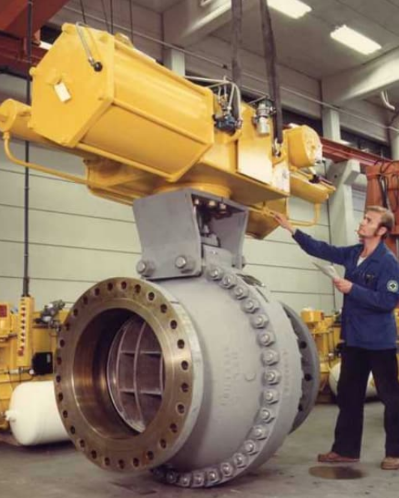
In July 2021, Valmet and Neles announced that their respective Boards of Directors had signed a combination agreement and a merger plan to combine the two companies through a merger. On April 1, 2022, the merger of Neles into Valmet was completed, bringing together two companies with complementary offerings. Neles’ former business and operations were organized in Valmet as the Flow Control business line. The flow control offering includes an industry-leading portfolio of valves, valve automation solutions and related services.

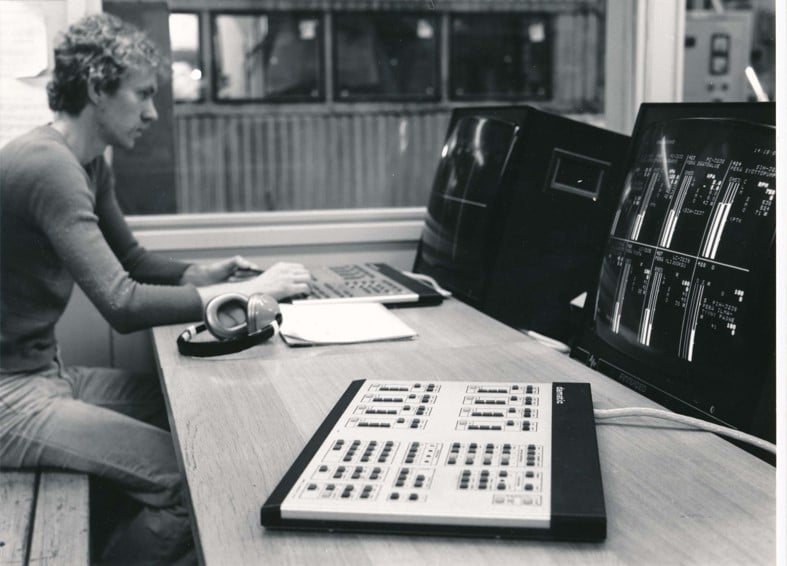
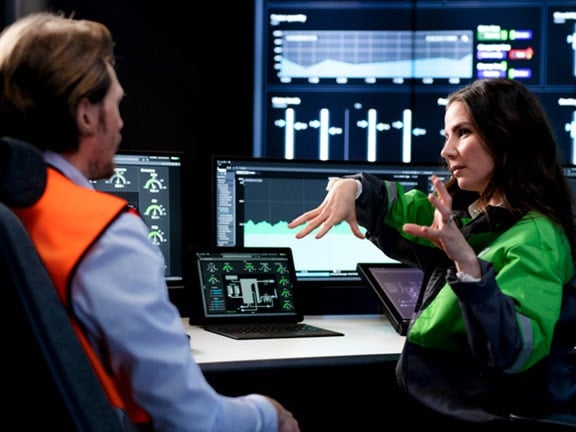
Two people are in a control room with multiple computer monitors displaying system data. One person seated, wearing a green jacket, is operating the computer, while another person standing beside them is pointing at the screen, likely giving instructions or explaining something. Other operators can be seen working in the background.

Automation becomes part of Valmet

2015

In January 2015, Valmet Corporation and Metso Corporation signed an agreement on the sale of Metso's Process Automation Systems business to Valmet. The acquisition was completed on April 1, 2015. The acquisition strengthened Valmet's competitiveness by creating a unique customer offering combining paper, pulp and power plant technology, services, process know-how and automation.

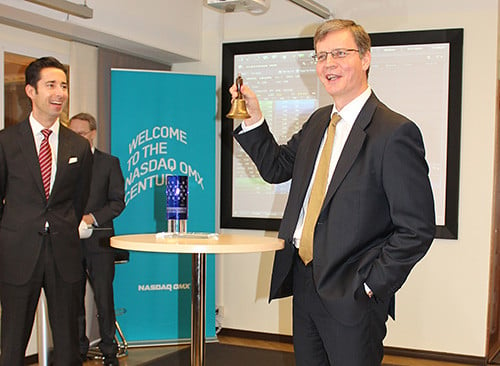
A man in a business suit is holding a small bell in one hand, standing beside a round table. Another man in a suit stands nearby, and a blue banner in the background reads “Welcome to the NASDAQ OMX”. The setting appears to be a formal financial or corporate event, such as a market opening ceremony.
Demerger from Metso into Valmet

2013

Metso Corporation’s Extraordinary General Meeting (EGM) held on October 1, 2013, approved the Board of Directors’ proposed plan for a partial demerger and decided to demerge Metso into two companies: Valmet and Metso. On December 31, 2013 Metso’s Pulp, Paper and Power business was transferred to the new company, Valmet Corporation, and the Mining and Construction and Automation business remained part of Metso.

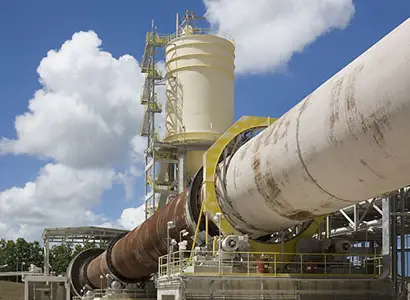
A large industrial rotary kiln system is shown outdoors under a bright blue sky with scattered clouds. The structure consists of a massive cylindrical drum supported by a metal framework and connected to a tall beige silo with ladders and platforms. The equipment is part of a heavy manufacturing or processing facility, likely used for material production or thermal treatment.

Lime kiln technology completed the offering for pulp industry

June 28, 2013

To complete its portfolio as a full scope supplier to the pulp industry Metso acquired in 2013 the lime kiln and recausticizing technology of the Danish company FLSmidth. This acquisition made then Metso Pulp, Paper and Power, now Valmet, a complete technology supplier for the pulp industry.
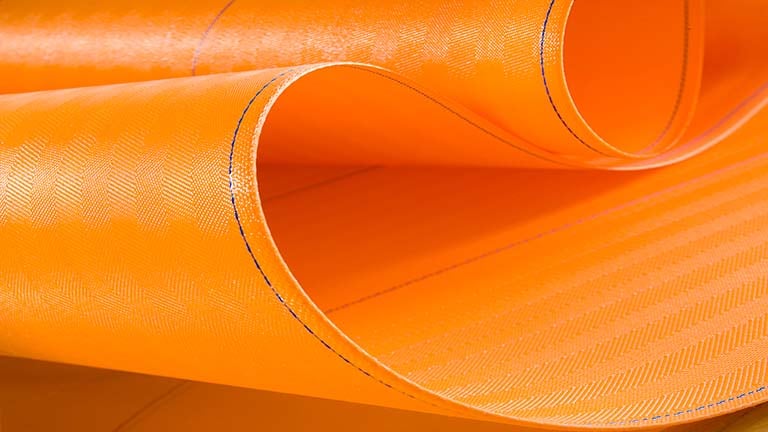
Close-up of bright orange industrial fabric or conveyor belt material, shown in smooth, curved layers. The surface has a fine textured pattern with subtle diagonal lines and visible stitching along the edges, indicating durability and precision engineering for industrial applications.

Tamfelt becomes part of Metso

2009

Tamfelt had become one of the world’s leading suppliers of technical textiles. On November 5th, 2009 Metso and Tamfelt agreed to combine their operations under the combination agreement. As a result, Metso made a public tender offer to purchase all of the issued and outstanding shares in Tamfelt. The combination strengthened Metso’s services business especially in the pulp and paper industry.

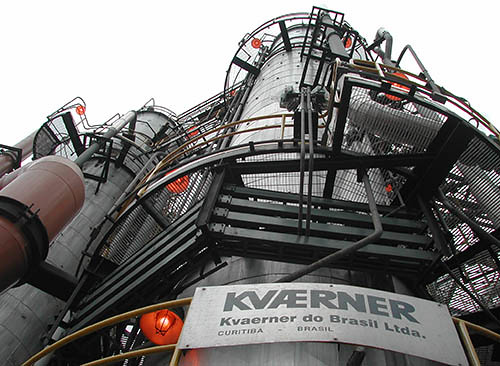
An upward view of large industrial towers and metal structures, featuring interconnected pipes, platforms, and railings. The foreground shows a sign reading “Kværner do Brasil Ltda., Curitiba – Brasil,” indicating the facility’s operator. The overall scene suggests a heavy industrial plant, likely involved in chemical, energy, or processing operations.

Metso acquired Kvaerner pulping and power

2007

The core of Kvaerner power business was acquired through mergers of the Swedish Götaverken and the Finnish Tampella boiler businesses. Kvaerner had further broadened its biomass product portfolio through the acquisition of the boiler business of Fortum Engineering, in 2002, and a majority acquisition of the Finnish boiler plant supplier Noviter Oy, in 2005. In January 2007, Metso acquired Aker Kvaerner’s pulping and power businesses. The former Kvaerner Pulping and Kvaerner Power operations became an integral part of Metso, and later formed the core of Valmet’s Pulp & Energy business line.

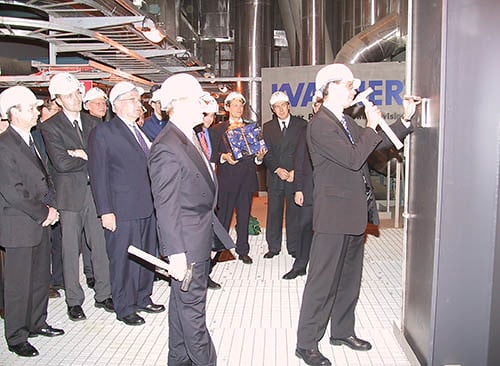
A group of people dressed in formal business attire and wearing white safety helmets are gathered inside an industrial facility. One individual in the foreground is signing or writing on a large metallic surface, while others look on. The scene suggests a ceremonial or official event, related to the inauguration of industrial equipment.

World class boiler technology

2001

In 2001 Kvaerner Power delivered world's largest biomass burning CFB (circulating fluidized bed boiler) to Alholms Kraft in Pietarsaari, Finland.

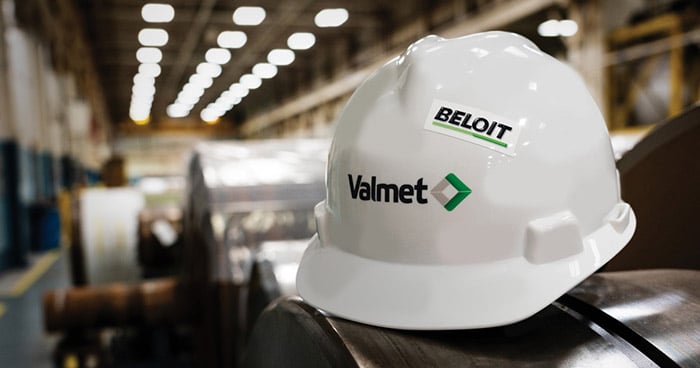
A white safety helmet with the logos "Valmet" and "Beloit" printed on it is placed on top of large industrial machinery or equipment inside a manufacturing facility. The background shows a factory setting with bright overhead lights and blurred industrial components, indicating an operational production environment.

Beloit becomes part of Metso

2000

In 2000, Metso acquired the service and aftermarket assets of North American Beloit. This acquisition covered Beloit’s roll cover division and the paper machine aftermarket with related paper machine technology. It strengthened Metso’s position in the maintenance and upgrades market. Beloit’s large base on installed machinery was also seen as a strong platform for growth.

The exterior of a modern building featuring large windows and a metallic facade displays a prominent sign with the Metso logo. The logo consists of a stylized red and white graphic element next to the word "metso" in bold gray letters, identifying the company's branding on the building, located at Fabiankatu.

Merger of Valmet and Rauma to form Metso

1999

Metso Corporation was created as a result of the merger of Valmet Corporation and Rauma Corporation (“Rauma”) in July 1999. At the time Valmet was a paper and board machine supplier, while Rauma’s operations were focused on fiber technology, rock crushing and flow control solutions. The merger produced an equipment supplier serving the global process industry. The new combined company was initially given the name Valmet-Rauma Corporation. The name was changed to Metso Corporation in August 1999. Shares in Metso were listed on the Helsinki Stock Exchange, which replaced the listings of its predecessor companies.

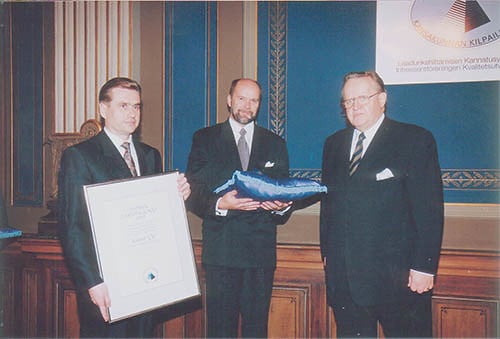
Three men, Martti Ahtisaari, Hannu Mälkiä and Martti Karttunen, in formal business attire are participating in an award ceremony inside an elegant room with ornate wooden paneling and blue walls. One man is holding a large framed certificate, while another is presenting an object wrapped in blue fabric. A banner with a logo is partially visible in the background, indicating an official or professional recognition event.

Quality award from the President

1997

Valmet’s Järvenpää unit was awarded the Finnish quality award (Suomen laatupalkinto) from President Martti Ahtisaari in 1997.The award was handed over to Hannu Mälkiä (from the left) and Martti Karttunen.

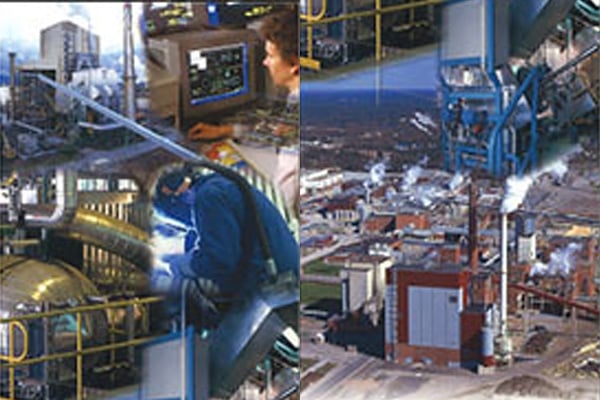
A collage of industrial-themed images shows various aspects of a manufacturing or processing facility. On the left, a person operates a computer monitor displaying technical data, and another individual in protective gear is welding inside a large metal structure. On the right, an aerial view of an expansive industrial plant with towers, pipes, and buildings is visible.

Götaverken and Tampella become part of Kvaerner

1991 — 1996

Götaverken Energi, which was established in 1841, was in 1991 acquired by the Norwegian Kvaerner. In 1994, after the merger of Kamyr and Götaverken, the company changed its name to Kvaerner Pulping. In 1996 Kvaerner Pulping is merged with Tampella, and the company is renamed to Kvaerner Power AB. This merger brought together two boiler businesses which had developed separately over a period of 150 years.

Tampella name disappears in the 1990s

1991 — 1996

As a result of financial crisis in late 1980s Tampella came to the ownership of the Bank of Finland and was reorganized into independent business groups and companies in 1991. Tampella’s forest industry and packaging operations were sold to Enso Gutzeit, and Valmet became the new owner of Tampella’s board machine production (Tampella Papertech Oy) in 1992. In 1996 Tampella Power, the chemical recovery, evaporation, and power generation technology businesses, was sold to Kvaerner, which had previously acquired also Götaverken.

Read more about us