A history of valve technology in service of the pulp & paper industry

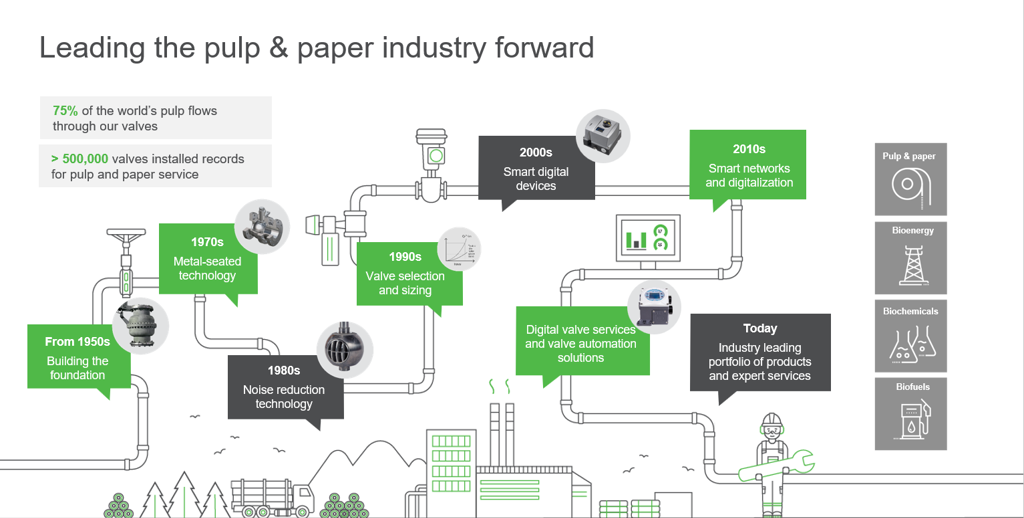
The pulp and paper industry has long been one of the proving grounds for flow control technologies. It has consistently pushed valve technology toward higher durability, tighter sealing, and greater operational reliability. Our first Neles™ valves were delivered for pulp and paper service some 70 years ago.
For Valmet, this sector has not only been a key customer segment for decades, but also a major driver of innovation for our valve brands such as Neles™ and Jamesbury™. Many of the solutions applied across process industries were originally developed to meet the challenges of pulp mills and paper machines.
The origins of pulp & paper specific valve technology
One of the clearest and earliest examples of pulp-driven valve development is the capping valve, introduced already in the 1960s for batch digester applications. In pulp production, the digester is a critical process unit, and its filling and closing operations must be performed safely, efficiently, and repeatedly under harsh conditions. Our Neles™ PZ capping valve was designed specifically for the automated opening and closing of batch digesters during chip filling, enabling more consistent operation while supporting improved plant safety and productivity.

Neles capping valves improve the customer process reliability, safety and efficiency
The significance of the capping valve lies not only in its original design, but in its ability to deliver performance over decades of service. Valmet has emphasized that maintaining long-term reliability requires a full life-cycle approach, combining robust engineering with planned refurbishment and staged replacement programs. Such practices allow mills to sustain high availability without taking unnecessary process risks – an essential factor in an industry where downtime carries exceptional cost.
The introduction of metal seating in valves
Beyond individual valve types, pulp and paper has played a central role in shaping broader design principles. One of the most important developments has been the widespread adoption of metal-seated valve structures, which can be found in our ball, segment and butterfly valves alike. Fibers in the flow media create sealing challenges and increases wear.
Metal seating provides the durability needed in these conditions, allowing the closing element to withstand and effectively cut through fiber material without compromising valve integrity. This technology, first developed for pulp applications, has become a foundation for Valmet’s high-performance metal-to-metal sealing valves used across multiple industries.
Innovation brings precision to modern papermaking
Precision requirements in papermaking have also contributed to Valmet’s innovation history. Paper machines depend on accurate and stable control to ensure uniform quality, and flow control components must perform reliably within tight process tolerances.
Through the decades, we have developed specialized solutions for demanding control applications, advancing both control performance and the mechanical durability of valves. Among the first were of course our recognized the NelesAce™ basis weight control valve and ceramic ball valves designed for service in erosive applications.
In recent decades, digitalization has become an equally important part of this evolution of technology. From early on, we have led the industry in digital valve controllers and positioners, advanced diagnostics, and predictive maintenance capabilities, supporting mills in improving reliability and reducing unplanned shutdowns.
The era of advanced trim technologies
Environmental and operational expectations have further expanded valve development in pulp and paper. Like in all industrial applications, in pulp and paper, valve designs that minimize fugitive emissions outside of the valve body as well as leakages inside the pipeline, are in high demand. Steam and utility processes, common throughout mills, require solutions that can address cavitation and noise. This led to innovations in advanced trim design such as our industry-leading Neles Q-trim technology.
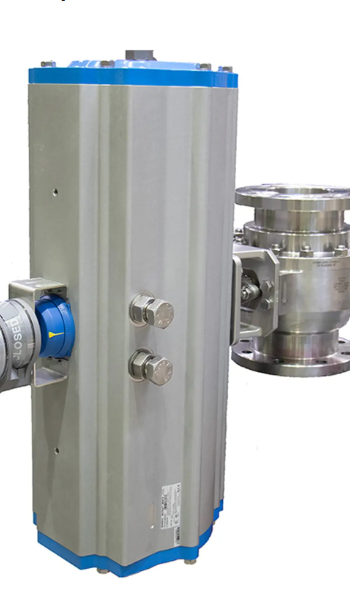
Neles M series pocket feeder valve for separator service in pulp and paper industry is designed for automatic removal of sand and other fine debris from the process.
Multi-stage trim technology has been instrumental in reducing process stress while improving environmental compliance, including noise reduction in sensitive operating areas. At the same time, erosive media, coatings, and fillers used in paper production created demand for highly wear-resistant components, including ceramic-based valve solutions in selected applications.
Development driven by industry demands
From the first digester capping valves to today’s intelligent flow control systems, the history of Valmet valves in pulp and paper reflects continuous development shaped by real process demands. The industry’s scale, conservatism, and high reliability requirements have ensured that innovation is never introduced for its own sake, but always to strengthen long-term performance, safety, and sustainability in one of the world’s most essential process industries. That’s why every valve product in our portfolio is based on field proven designs with improvements enabled by technological development over the years.
Read more on